The Ontology Renaissance: Why a Decades-Old Discipline Now Powers AI
TL;DR — Ontology — the formal, machine-readable map of what your business objects mean and how they relate — sat unloved for thirty years. AI just made it indispensable. Large language models and vector search give you proximity ("invoice" sits near "customer"); only an ontology gives you meaning (a customer owns an invoice, which must reconcile to a payment). The gap is now measured: in the most-cited enterprise study, GPT-4 scored 16% accuracy answering questions straight against SQL tables vs 54% over a knowledge-graph representation of the same data. In June 2026 Databricks named its flagship launch Genie Ontology and bet it can auto-build the context layer that Palantir built by hand — the static-to-dynamic shift the whole market is now racing toward. This piece covers what ontology really is, why AI revived it, how Palantir and Databricks differ, who else is in the fight, what it means for APAC enterprises under PDPA and MAS, and how data leaders should respond.
There is a special category of technology concept that is too old to be exciting and too unglamorous to fund. Ontology sat in that category for thirty years. It was the domain of librarians, knowledge engineers, and the kind of enterprise architect who drew boxes-and-arrows diagrams nobody read. This June, Databricks named its flagship AI launch Genie Ontology — and a word that used to clear a room became the headline.
That is worth pausing on. Because the story of how ontology went from dusty to decisive is, quietly, the story of what AI actually needs to stop making things up.
What ontology really is (and why it was boring)
The canonical definition is 33 years old. In 1993 Tom Gruber called an ontology "an explicit specification of a conceptualization" — where a conceptualization is the set of objects, concepts, and relationships presumed to exist in a domain, and explicit means each concept, attribute, relationship, and rule is precisely articulated through formal semantics. Borst later tightened it to "a formal specification of a shared conceptualization," adding the part that makes it useful in an enterprise: it has to be shared and reusable, not one analyst's private mental model.
Strip the academic phrasing and an ontology answers plain questions. What is a "customer"? What is an "invoice"? Does a customer own an invoice? Must that invoice reconcile to a payment? An ontology writes those answers down in a structured, machine-readable form — classes, properties, relationships, and the rules that constrain them.
For most of its life this was tedious, manual, static work. A team of humans would argue about definitions, encode them in OWL or RDF, and ship a model that was correct on the day it was written and decayed afterward. The payoff was abstract, and analysts — being clever — just worked around the gaps in their heads. The ontology was nice-to-have governance, not a system that did anything. That is the version most data professionals filed away years ago, and it was the right call at the time. The economics never justified the effort — until the consumer of the ontology changed from a human to a machine.
Why AI dragged it back from the dead
A large language model is a remarkable thing and a context-blind one. It generates fluent text by predicting which tokens statistically belong near which other tokens. Modern retrieval extends this with embeddings: convert documents into vectors and fetch the ones closest to the question. This is powerful, and it is also the source of the confusion in the market right now.
Embeddings give you proximity. Ontology gives you meaning. Those are not the same thing, and the gap is now measurable.
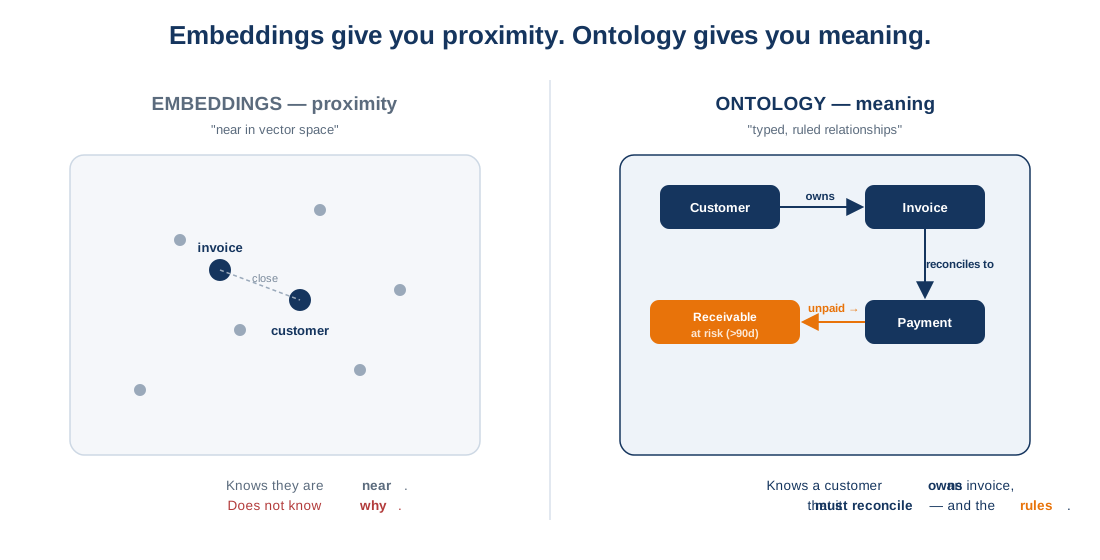
Proximity is geometric; relationships are logical. An embedding knows "invoice" and "customer" are close — not that one owns the other, must reconcile to a payment, or becomes a receivable-at-risk after 90 days.
An embedding model knows that "invoice" and "customer" sit near each other in vector space. It does not know that a customer owns an invoice, that an invoice must tie to a payment, or that an unpaid invoice past 90 days is a different business object — a receivable at risk — with its own rules. Similarity is geometric. Relationships are logical. No amount of clustering similar tokens recovers a rule that was never statistical to begin with.
This stopped being a philosophical point the moment people benchmarked it. The evidence now points one way:
| Evidence | Setup | Result | Read with |
|---|---|---|---|
| data.world enterprise study (Sequeda, Allemang & Jacob, 2023) | GPT-4, zero-shot SQL straight against a relational DB vs the same questions over a knowledge-graph representation | 16% → 54% accuracy (3.4× lift, identical model) | Peer-reviewed; the most-cited number in the debate |
| Databricks Genie Ontology (launch, Jun 2026) | Agent grounded in ontology vs a comparison approach | 84.5% vs 52.4% first-attempt accuracy | Vendor figure, pending independent replication |
| Graph-RAG vendor benchmarks (Neo4j, FalkorDB, Fluree) | Pure vector retrieval vs graph-grounded, as entities-per-query rises | Vector degrades sharply on schema-bound queries (KPIs, forecasts); graph holds up | Supplier claims — trust the pattern, not the digits |
| NAACL 2024 survey — Can Knowledge Graphs Reduce Hallucinations in LLMs? | Catalogue of KG-augmentation techniques | KG augmentation consistently mitigates hallucination | Independent academic survey |
The headline result — GPT-4 going from 16% to 54% purely by being handed structured meaning instead of raw tables — reframes the whole problem. Vendor-published graph-RAG benchmarks point the same way, with the usual caution about supplier figures: they report pure vector retrieval degrading sharply as entities-per-query rises, struggling most on schema-bound queries like KPIs and forecasts — exactly the questions enterprises actually ask — while graph-grounded retrieval holds up better.
The academic literature has converged on the same conclusion. The 2024 NAACL survey, "Can Knowledge Graphs Reduce Hallucinations in LLMs?", catalogues the techniques and finds KG-based augmentation consistently mitigates hallucination. Follow-on work — OntoTune's ontology-driven self-training, ontology-constrained verification using Description Logic reasoning, ontology-grounded KG construction under the Wikidata schema, and HybridRAG combining graph and vector retrieval — all rests on one premise: meaning isn't measurement. A semantic layer can tell you what revenue equals; an ontology can tell you that a customer is a class, with attributes, related to products and transactions, governed by constraints. (This is the same semantic-layer foundation we covered in What a Modern Data Platform Architecture Must Include in 2026 — ontology is that layer's logical extension.) A human analyst could paper over a thin data model with intuition. An autonomous agent cannot — it needs the relationships made explicit, or it hallucinates them.
So the thing that makes ontology suddenly indispensable is precisely the thing that made it boring: it encodes the connective tissue that statistics can't infer. The old discipline turns out to be the missing context layer for the new machine.
Palantir wrote the template
Credit where due: Palantir is why anyone says "ontology" in a sales meeting at all. Its Ontology is a governed, typed, live, bidirectional knowledge graph positioned as the authoritative digital twin of the enterprise. Critically, it unifies two halves: the semantic elements — the nouns, objects and properties — and the kinetic elements — the verbs, actions, logic functions, and security policies. Data, logic, and actions live in one coherent model, and the LLM is handed context from that model rather than from a pile of fragmented documents. With AIP Analyst now giving conversational access to the ontology and AIP Autopilot driving agentic workflows, it is the most concrete implementation of the "ontology-first AI" thesis in production today.
[Diagram to add: Palantir Ontology — the semantic half (objects, properties, links) fused with the kinetic half (actions, logic functions, security policies) over a typed, bidirectional graph. Source reference: Palantir AIP / Ontology architecture documentation.]
The catch is in the how. Palantir's ontology is heavily human-curated, delivered inside a closed platform, and historically services-intensive to stand up. It is powerful precisely because skilled people pour structure into it — which is also its ceiling. It reflects the effort humans invest, and it costs real money to keep current. That is the template Databricks just tried to break.
What Databricks actually changed
On 16 June 2026, Databricks announced Genie One — an agentic "coworker" for business teams — alongside Genie Agents (shareable autonomous agents) and, beneath both, Genie Ontology. Genie One is the umbrella product and Genie Agents are the actors; Genie Ontology is the context layer that makes either trustworthy. It is the Ontology that matters for this argument.
Genie Ontology is described by Databricks as an automatic, self-improving context layer. Instead of asking humans to hand-author the model, it continuously extracts knowledge from the data exhaust an enterprise already produces — tables, queries, dashboards, pipelines, tickets, chats, and connected apps (via Lakehouse federation and two-way integrations to Gmail, Slack, and Teams) — and organizes it into, in their words, "a living graph of how a company works and what the data inside actually means." It captures metric definitions, business terms, bespoke calculations, and "the relationships between concepts, metrics, tables, and teams."
The architecture underneath is a multi-agent pipeline, and the details matter beyond the marketing:
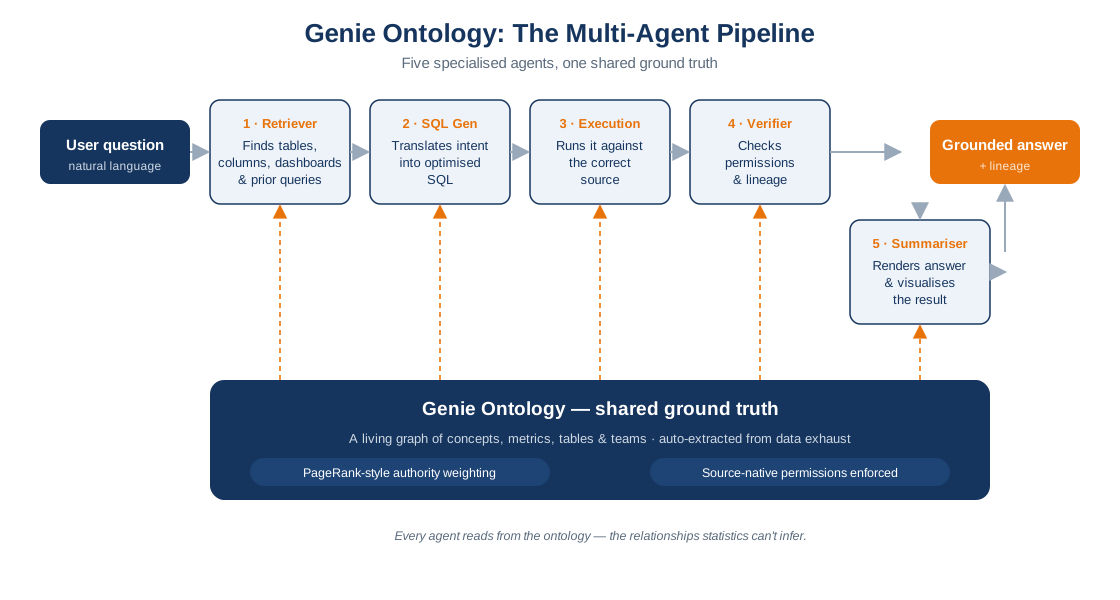
Five specialised agents — retriever, SQL-generation, execution, verifier, summariser — all read from one shared ontology, weighted by authority and bounded by source-native permissions.
- A retriever/grounding agent finds the right tables, columns, dashboards, and prior queries; a SQL-generation agent translates intent into optimized SQL; an execution/adapter agent runs it against the correct source; a verifier/safety agent checks permissions and lineage; a summarizer/visualization agent renders the answer. The ontology is the shared ground truth all five read from. (If that five-agent hand-off pattern feels familiar, it is the same multi-agent orchestration logic we unpack in Agentic Data Engineering in 2026 — here pointed at question-answering instead of pipelines.)
- It uses a PageRank-like authority weighting to decide which definition of a term to trust — based on source origin, author authority, how often people rely on it, proximity to certified assets, and freshness. That is a real answer to the oldest fight in enterprise data: whose definition of "active customer" wins?
- It enforces source-native permissions, so the graph doesn't become a backdoor around access control.
- Databricks' own numbers credit this grounding with a large agent-accuracy lift — a self-reported 84.5% first-attempt accuracy versus 52.4% for a comparison approach — by retrieving real answers from governed data rather than guessing from incomplete context. As with any launch metric, it is a vendor figure pending independent replication, but it is directionally consistent with the published research on graph grounding.
The conceptual move is the headline. Palantir made ontology valuable by having humans build it. Databricks is betting it can make ontology scalable by having the system build and refresh it. Human-curated static ontology → machine-built dynamic ontology. Whether an auto-built graph earns the same trust as a hand-built one is the open question — automatic extraction is exactly where silent errors hide — but the direction of travel is unmistakable.
The bigger pattern: the context layer is the battleground
Look up from the two-vendor fight and a pattern resolves. Everyone is racing to own the same layer under a different name — and, tellingly, everyone is racing to auto-generate it.
| Vendor | The "context layer" play | How it's built | Posture |
|---|---|---|---|
| Palantir | Ontology — typed, bidirectional graph; semantic (nouns) + kinetic (verbs/actions) | Human-curated, AIP-assisted | Closed, services-heavy, most mature |
| Databricks | Genie Ontology — self-improving graph over the Lakehouse | Auto-extracted from data exhaust; PageRank-weighted | Automatic, governance-native via Unity Catalog |
| Snowflake | Cortex Analyst + Semantic Views (native object since Summit '25) | Semantic View Autopilot auto-generates DDL, infers relationships (GA Feb 2026) | Warehouse-first, tightly integrated |
| Microsoft | Fabric IQ semantic layer + Graph on OneLake (LinkedIn graph tech) | Cross-domain semantic models, MCP-exposed | Broadest surface area, agent-ready estate |
| BigQuery + Gemini, deep knowledge-graph heritage | Semantic layer still assembling | Strong model + retrieval, layer maturing |
Two things jump out. First, the model layer is commoditizing — frontier LLMs are converging in capability and falling in price, so durable differentiation is migrating down to whoever owns the structured, governed, relationship-rich context the models reason over. Second, and more striking still: the static-to-dynamic shift is not a Databricks quirk, it is an industry move. Snowflake's Semantic View Autopilot now generates semantic DDL automatically — "days to minutes," in their phrasing. Microsoft's Fabric IQ structures OneLake data by business semantics for agents. Databricks auto-builds its ontology from usage. The whole market has concluded that the only way to make a semantic/ontology layer cover a real enterprise is to stop hand-building it.
This is why Databricks branding its launch Ontology rather than Agent or Copilot is the tell. It is not selling a smarter chatbot. It is staking a claim on the substrate beneath every agent.
Where this leaves Databricks
For Databricks specifically, Genie Ontology slots cleanly into a story it has been building for years. Unity Catalog already governs the data and now anchors the permissions for the ontology. The Lakehouse already unifies structured and unstructured data — the raw material the graph feeds on. Agents sit on top and act. Against warehouse-first rivals, the pitch is coherent: we already hold all your data in one governed place, so we are best positioned to build the living map of what it means. It converts Databricks' longstanding "one platform" argument into an AI-era argument without inventing a new narrative.
The risk is equally clear, and it is the mirror image of the opportunity. An auto-extracted ontology is only as good as its extraction, and a confidently wrong knowledge graph is more dangerous than no graph at all — it launders error into authority. The 16%→54% benchmark cuts both ways: the lift comes from the graph being correct. Snowflake leans on verified query examples and human-reviewable YAML for the same reason; Palantir leans on human curation. Databricks' PageRank-style authority weighting is a smart hedge, but trust will be earned in production logs, not in a launch blog.
What this means for APAC enterprises
The vendor race is framed in Silicon Valley terms. For data leaders in Singapore and across APAC, an auto-built context layer lands inside a stricter set of constraints — and that changes the calculus.
- Data sovereignty meets "data exhaust." Genie Ontology's power comes from extracting knowledge across tables, queries, tickets, chats, and connected apps like Gmail, Slack, and Teams. For PDPA-bound organizations — and especially MAS-regulated financial institutions — a graph that auto-reaches across operational and communication systems raises immediate questions of data residency, classification, and cross-border flow. Source-native permission enforcement helps, but the scope of what the graph ingests must be governed deliberately, not left to "extract everything."
- "Whose definition wins" is now a compliance question. PageRank-style authority weighting is, in effect, automated metric stewardship — and that collides directly with the MAS Data Governance Guidelines (Feb 2024), which expect CDO accountability and auditable lineage for how data definitions are set. An auto-weighted "active customer" or "receivable at risk" needs human-reviewable governance and, under MAS TRM (2021), immutable audit trails for any agentic action that reads, writes, or transforms regulated data. Convenient automation cannot become an ungoverned source of truth.
- The regional vendor reality differs from the US framing. Databricks runs in Singapore (AWS/Azure regions) and Unity Catalog maps reasonably onto PDPA/MAS technical-enforcement expectations — a genuine advantage for the Genie pitch here. But Microsoft-centric APAC enterprises will weigh Fabric IQ, warehouse-first shops will weigh Snowflake Cortex/Semantic Views, and organizations with Greater China operations face sovereignty considerations (e.g. Huawei Cloud estates) that the US-centric vendor race simply ignores. The "best context layer" is the one that fits your regulatory and platform reality, not the one with the best launch benchmark.
- A pragmatic path for the APAC mid-market. Most mid-market enterprises here lack the internal bench strength to independently evaluate ontology claims — let alone govern an auto-built graph in production. The sensible sequence: start by formalizing a governed semantic layer on your existing platform; pilot auto-extraction on a single bounded domain (one business unit, one set of metrics); keep human review on the authority weighting before any regulated workflow trusts it; and insist on lineage and audit from day one. Adopt the dynamic ontology — but earn the trust incrementally, the way the regulators will expect you to.
So — is static ontology now the core of dynamic AI?
Yes. And the framing deserves to be flipped one more turn.
The old objection to ontology was that it was static — fixed on the day it shipped, decaying after. The AI era didn't rescue ontology by keeping it static and finally finding it a job. It rescued ontology by making it dynamic: a context layer that builds, weights, and refreshes itself, that an agent reads at inference time, that changes as the business changes. The most boring, most manual idea in data is becoming the most alive part of the stack — and the benchmarks say it is also the part that decides whether your agents are right or merely fluent.
Which means the question for any data leader in 2026 is no longer "which model should we use?" The models will keep getting better and cheaper without your help. The real question is: who is building the map of what your business means — you, or your platform vendor? In the agentic era, that map is the moat. Ontology is having its renaissance, and the only mistake left is to keep treating it as boring.
Where DataMy fits
The context-layer race is real, fast-moving, and easy to get wrong — and the cost of getting it wrong (a confidently incorrect graph in a regulated workflow) is higher in APAC than almost anywhere. DataMy helps enterprises across Singapore and APAC cut through it:
- Ontology & context-layer readiness assessment — where your semantic foundation stands today, and what an agent would actually hallucinate against it.
- Vendor-neutral evaluation — Databricks Genie Ontology vs Snowflake Semantic Views vs Microsoft Fabric IQ vs Palantir vs data-virtualization approaches, scored against your platform estate and regulatory profile, not a launch benchmark.
- Governed implementation — building the semantic/ontology layer with PDPA- and MAS-aligned lineage, authority governance, and audit from the start.
If your agents are about to reason over your business, make sure they know what it means first. → Talk to us at [email protected] for an ontology-readiness conversation.
FAQ
What is Databricks Genie Ontology? An automatic, self-improving context layer announced 16 June 2026 that extracts a "living graph" of an enterprise's concepts, metrics, tables, and relationships from its existing data and connected tools, then grounds Genie's agents in it. It sits beneath Genie One (the business-user coworker) and Genie Agents.
How is an ontology different from a semantic layer? A semantic layer defines business metrics (what "revenue" equals). An ontology is broader: it defines objects, their attributes, the typed relationships between them, and the rules that constrain them (a customer owns an invoice that must reconcile to a payment). Ontology is the logical extension of a semantic layer.
Knowledge graph vs vector RAG — which is more accurate? For schema-bound enterprise questions (KPIs, forecasts), graph-grounded retrieval consistently outperforms pure vector similarity. The most-cited study found GPT-4 jumping from 16% to 54% accuracy when answering over a knowledge graph instead of raw SQL tables — same model, structured meaning added.
How is Genie Ontology different from Palantir's Ontology? Palantir's ontology is human-curated inside a closed, services-intensive platform and is the most mature in production. Databricks' is auto-extracted from data exhaust and weighted by a PageRank-style authority score. The trade-off is curation-quality vs scale: hand-built trust vs machine-built coverage.
Is an auto-built ontology safe for regulated industries? Only with governance. An incorrect auto-extracted graph "launders error into authority." For PDPA/MAS contexts, you need bounded extraction scope, human-reviewable authority weighting, source-native permissions, and immutable audit trails before trusting it in regulated workflows.
Sources
Vendor / primary:
- Databricks — Introducing Genie One, Genie Ontology, and Genie Agents (blog, 16 Jun 2026) and Pushing the Frontier for Data Agents with Genie
- Palantir — Ontology system & AIP documentation; Inside Palantir AIP (Towards AI)
- Snowflake — Cortex Analyst & Semantic Views docs; Semantic View Autopilot GA (Feb 2026)
- Microsoft — Fabric IQ overview (Microsoft Learn); Graph on OneLake (Build 2026)
Academic / research:
- Gruber, T. (1993) — A Translation Approach to Portable Ontology Specifications ("explicit specification of a conceptualization"); Stanford KSL, What is an Ontology?
- Sequeda, Allemang & Jacob (2023) — A Benchmark to Understand the Role of Knowledge Graphs on LLM Accuracy for QA on Enterprise SQL Databases, arXiv:2311.07509 (GPT-4: 16% → 54% with KG)
- Can Knowledge Graphs Reduce Hallucinations in LLMs? — A Survey, NAACL 2024 (ACL Anthology)
- Combining LLMs and Knowledge Graphs to Reduce Hallucinations in QA, arXiv:2409.04181
- HybridRAG: Integrating Knowledge Graphs and Vector RAG, arXiv:2408.04948
- OntoTune: Ontology-Driven Self-Training for Aligning LLMs (2025); Ontology-grounded Automatic KG Construction under Wikidata schema, arXiv:2412.20942
- GraphRAG vs. vector RAG benchmarks — Neo4j, FalkorDB, Fluree (vector RAG → ~0% on multi-entity / schema-bound queries)
Related reading
- What a Modern Data Platform Architecture Must Include in 2026 — the six-layer foundation, including the semantic layer this ontology shift extends.
- Agentic Data Engineering in 2026: Why Your Data Platform Needs Multi-Agent Orchestration — the multi-agent pattern Genie applies to question-answering.