Agentic Data Engineering in 2026: Why Your Data Platform Needs Multi-Agent Orchestration
By DataMy — APAC Data & AI Consultancy | Published 14 June 2026
TL;DR — Agentic data engineering is the practice of running coordinated teams of AI agents — rather than a single LLM — to operate data pipelines: ingestion, modeling, governance, quality, and ML. Single agents fail on these multi-step, cross-system tasks for four structural reasons. In 2025–2026, every major data platform (Snowflake, Databricks, Dataiku) shipped a native multi-agent orchestration product, and the Fivetran + dbt Labs merger created the first integrated ingestion-to-transformation agent stack. This guide covers the architecture, the vendor landscape, and eight data domains where orchestration is already in production.
Key Takeaways
# Takeaway 1 Single-agent AI fails on complex data tasks due to four structural reasons — not model quality 2 Every major data platform (Snowflake, Databricks, Dataiku) has shipped a native multi-agent orchestration product in 2025–2026 3 Platform-native agents (governed, context-grounded) and framework-based agents (flexible, cross-platform) serve different needs — most enterprises need both 4 Data governance for agents is now a first-class product: Snowflake AI Agent Identity, Databricks Unity AI Gateway, and Dataiku Agent Management each solve different parts of it 5 The Fivetran + dbt Labs merger (June 2026) created the first integrated ingestion-to-transformation agent stack with four native dbt agents 6 Before any agentic deployment: build your semantic layer and populate your data catalog — agents grounded in governed context outperform generic RAG by up to 86% vs 24% on structured data questions
In this article: The Single-Agent Illusion · Why It Breaks · Decision Framework · Architecture Anatomy · Platform-Native vs. Framework-Based · What Data Platforms Have Built · Eight Data Domains · Protocol Stack · Production Reality · FAQ · What This Means
The Single-Agent Illusion
Every AI agent demo looks like this: one model, one input, one output. The agent reasons through the task, executes a few tool calls, and returns the result. Clean. Ready for the keynote stage.
Then you try to wire it into a real data pipeline. An ingestion job that must handle API rate limits, schema drift, and partial failures across 15 sources simultaneously. A data modeling workflow that needs to discover the right tables, validate SQL against a governed semantic layer, generate tests, and deploy — with a code review in between. A governance workflow where a schema change needs impact analysis, approval, policy enforcement, lineage update, and audit logging, with human sign-off at specific gates.
None of these are one-agent problems. They are systems problems. And the industry is learning — at production cost — that single-agent AI cannot handle them reliably.
The failure modes are consistent: hallucinated intermediate steps, context window exhaustion under parallel load, opaque audit trails, and general-purpose models underperforming in specialized roles. The bigger the data task, the worse these compounds.
This is not a model quality problem. It is an architecture problem. The answer is multi-agent orchestration — and the data platform market has spent the last twelve months building exactly that.
What is agentic data engineering? Agentic data engineering is the use of multiple coordinated AI agents — each with a specialized role, a scoped set of tools, and its own context — orchestrated to operate data workflows end to end. Instead of one large language model attempting an entire pipeline in a single pass, an orchestrator agent decomposes the task and delegates to specialist agents for ingestion, transformation, validation, governance, and remediation, with human approval enforced at defined gates. It is the data-domain application of multi-agent orchestration.
Why Single-Agent AI Breaks in Data Production: Four Structural Failures
There are four structural failure modes that apply regardless of model provider:
1. Context window exhaustion. Validating 200 tables before a warehouse migration requires holding schema, validation rules, intermediate results, and dependency state simultaneously. A single agent compresses earlier state to make room for new operations and silently loses precision. Multi-agent systems decompose the task — each sub-agent handles a bounded slice with a fresh context while an orchestrator tracks overall state.
2. No native parallelism. Ingesting from 15 sources sequentially takes 15× longer than in parallel. Multi-agent fan-out achieves 5–15× wall-clock improvement on parallelizable data workloads — a meaningful difference in pipeline SLAs.
3. Auditability collapse. When a single agent executes a 40-step data workflow, the audit trail is one long LLM conversation log. Multi-agent systems produce structured, attributable logs by design: each sub-agent's inputs, outputs, and tool calls are independently logged and traceable to a specific role. This is the property that makes agent activity auditable for compliance teams.
4. Specialization vs. generalism. A single agent acting as data ingestion expert, dbt model author, quality engineer, and governance analyst simultaneously underperforms in every role. Specialist agents with narrow scope, role-specific system prompts, and access only to relevant tools outperform generalists on each domain — measurably so in production deployments.
Decision Framework: Which Domains to Automate First
Before going deep on architecture and vendor capabilities, the question most data teams should answer first is where to start — because the prerequisite readiness varies significantly by domain.
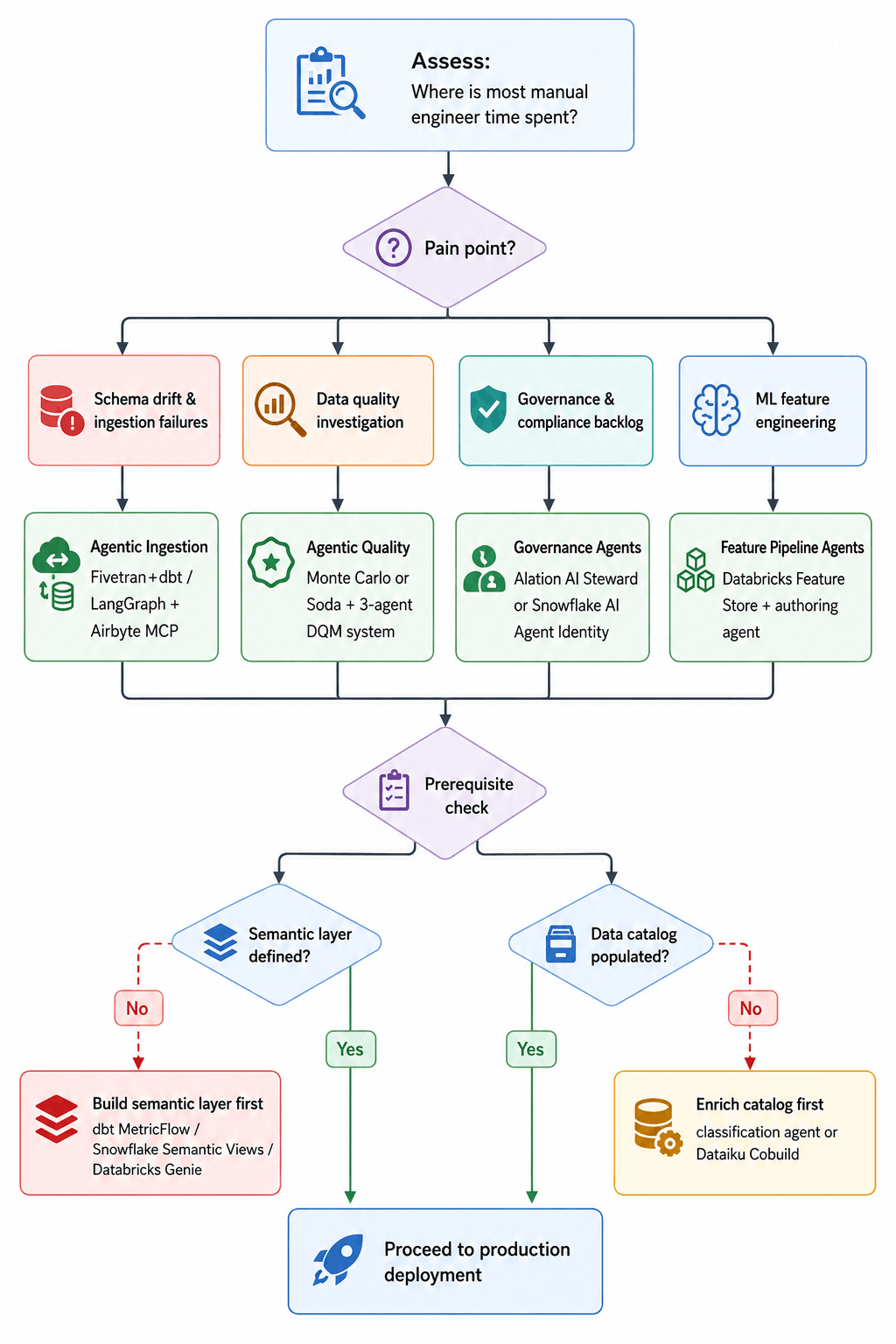
Multi Data Agent Orchestrator Decision Framework
Two prerequisites are non-negotiable:
Semantic layer first. Agents that generate SQL or compute metrics must have access to governed metric and dimension definitions. Without one, they generate syntactically correct SQL that computes semantically wrong answers — and do so confidently. Snowflake's benchmark shows agents using a runtime business context layer answer structured data questions at 86% accuracy versus 24% for generic models querying raw tables.
Catalog coverage first. Discovery agents, classification agents, and lineage agents are blind to whatever the catalog does not cover. If your catalog covers 20% of tables, your agents can only govern 20% of the estate. A catalog enrichment agent — the lowest-risk, highest-ROI starting point for most organizations — can raise coverage before other agentic workloads go live.
The Architecture: Orchestrator + Specialists
Every effective multi-agent data system implements some variation of the same core pattern:
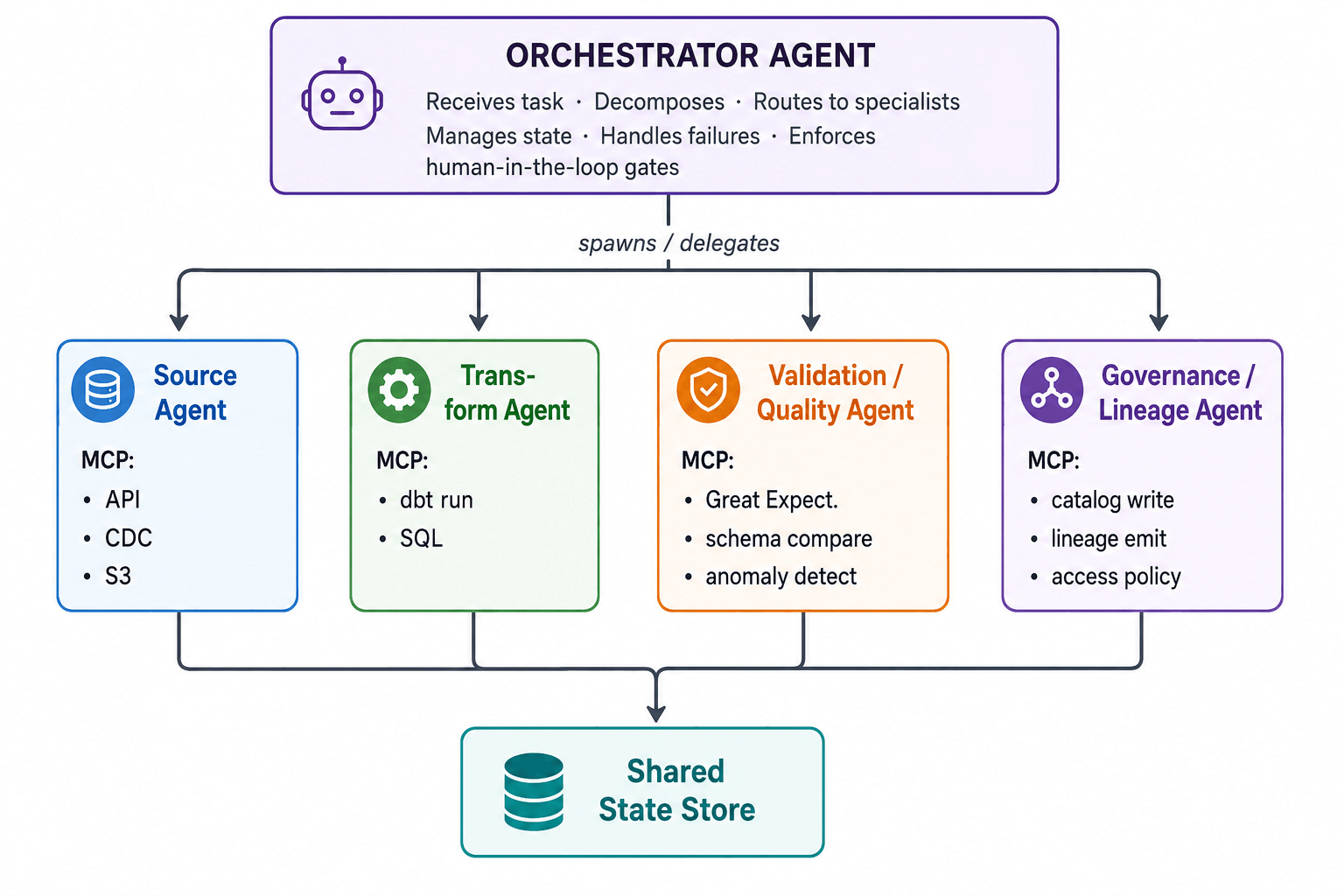
Multi Data Agent Orchestration
The orchestrator never directly touches data. It reasons about tasks, delegates to specialists, monitors results, and handles failures. Specialists are narrow, fast, and auditable. Shared state carries pipeline results across agents without routing everything through the LLM's context window.
This pattern — with variations in naming and implementation — is common to every major system discussed in this article: Snowflake Cortex Agents, Databricks Agent Bricks, Dataiku Agent Hub, LangGraph, OpenAI Agents SDK, and AutoGen.
Platform-Native vs. Framework-Based: The Architecture Choice
The agent orchestration market has split into two camps that data teams must understand before choosing an approach:
Platform-native orchestration means running agents inside the data platform itself — Snowflake Cortex Agents, Databricks Agent Bricks, Dataiku Agent Hub. Agents inherit existing access controls, use the semantic layer and catalog for context grounding, and emit audit events through existing logging infrastructure. Governance is not rebuilt for agents — it extends.
Framework-based orchestration means building workflows outside the data platform using LangGraph, OpenAI Agents SDK, AutoGen, or CrewAI, connecting back to data systems via MCP servers. The advantage is flexibility: mix models, span multiple platforms, and implement patterns platform-native tools don't yet support. The cost is that governance must be deliberately re-engineered at every layer.
| Dimension | Platform-Native | Framework-Based |
|---|---|---|
| Governance baseline | Inherited from existing RBAC and audit | Must be built (Unity AI Gateway, custom) |
| Data context grounding | Automatic via semantic layer + catalog | Manual via MCP + prompt engineering |
| Cross-platform orchestration | Limited to one platform | Strong — MCP + A2A bridges any stack |
| Agent identity | Cryptographic (Snowflake) or on-behalf-of (Databricks) | Depends on framework + MCP config |
| Time to production | Fast — governance is pre-built | Slower — governance must be designed |
| Flexibility for niche workflows | Limited to platform surface | High — any model, any pattern |
| Audit trail | Native (Delta tables, Snowflake audit logs) | Requires MLflow or custom logging |
Most mature enterprises in 2026 run both: platform-native agents for the governed core (quality checks, catalog enrichment, ML pipeline automation inside the warehouse), and framework-based agents for cross-platform workflows that span multiple systems or require model selection flexibility.
What the Data Platforms Have Actually Built
The most important development of the past twelve months is not a new LLM capability. It is that the data platforms themselves — Snowflake, Databricks, and Dataiku — have shipped production-grade multi-agent orchestration systems. These are not feature releases. They are platform repositioning moves.
Snowflake — Cortex Agents: Agents Inside the Governed Perimeter
Snowflake positions itself explicitly as "the control plane for the agentic enterprise" — meaning agents run inside Snowflake's governed perimeter, inheriting existing access controls and semantic context without rebuilding them for AI.
- Cortex Agents (GA Nov 2025): Fully managed agent platform handling the full loop — reason, plan, call tools, execute code, respond — with built-in multi-tenancy, per-agent credit budgets, and Agent GPA evaluation (Goal-Plan-Action) that catches up to 95% of errors.
- Cortex Sense: Runtime context layer assembling business definitions and semantic views at query time. Benchmark: 86% accuracy on structured data questions vs. 24% for generic models on raw tables — the quantified value of grounding agents in a governed semantic layer.
- AI Agent Identity (GA, Summit 2026): Cryptographic, verifiable identity per agent — not delegated user credentials. Per-agent RBAC and dynamic data masking by agent type, independent of the invoking user's session.
- Data Science Agent (Private Preview, powered by Claude): Autonomously plans and executes full ML pipelines — data analysis, feature engineering, model training — as executable Snowflake Notebooks.
- CoWork / CoCo (Summit 2026 rebrands): Knowledge-worker agent (CoWork, formerly Snowflake Intelligence) and coding agent (CoCo, formerly Cortex Code — adopted by 50%+ of customers within six months of launch) built on top of Cortex Agents.
For data teams, Snowflake's advantage is speed to governed production: the semantic layer, catalog, access controls, and agent runtime are all in the same system. The trade-off is that agents are scoped to what Snowflake exposes — cross-platform workflows require additional tooling.
Databricks — Agent Bricks: Governance That Travels With Every Agent
Databricks was named a Leader in the IDC MarketScape: Worldwide Unified AI Governance Platforms 2025–2026, and its philosophy is distinct from Snowflake's: rather than a single governed perimeter, Databricks extends Unity Catalog's governance infrastructure to cover everything an agent touches, regardless of which model or framework is used.
- Agent Bricks (GA): Multi-AI by design — 63% of Databricks customers route agent tasks across two or more model families. Agents leverage Unity Catalog metadata (schema, definitions, lineage, permissions, data quality signals) directly in reasoning, claiming 70% higher accuracy than standard RAG and 30% improvement in multi-step workflows.
- Genie Spaces: Registered business definitions that agents reason over instead of raw column names — the Databricks equivalent of Cortex Sense.
- Unity AI Gateway (expanded April 2026): Governs at the interaction level — MCP server registration with Service Policies (UC functions evaluating whether each tool call proceeds), on-behalf-of (OBO) token passing, guardrails for PII/prompt injection/hallucination, and full request/response payloads logged to Delta tables for compliance audit.
- MLflow 3.0: Auto-instruments LangChain, LlamaIndex, AutoGen, and Anthropic/OpenAI SDKs — traces land as queryable Unity Catalog tables without per-framework instrumentation.
For data teams, Databricks' advantage is openness: bring your own frameworks (LangGraph, CrewAI, OpenAI Agents SDK) and Unity AI Gateway adds the governance layer on top, without requiring a rebuild inside a proprietary runtime.
Dataiku — Platform for AI Success: The Cross-Platform Governance Layer
Dataiku's pitch is the most differentiated of the three: not a data warehouse with agent features, but a platform that governs agents regardless of which models, data platforms, or external systems they use — a control plane over a multi-vendor AI estate.
- Agent Management (GA April 2026): Cross-platform monitoring that measures each deployed agent's business impact against defined KPIs — not just access controls, but whether the agent is delivering the outcome it was built for. Alerts on model drift and cost overruns across agents running anywhere.
- Cobuild (GA June 18, 2026): Business users describe an objective in natural language; Cobuild generates a complete, governed, production-ready AI project — pipelines, models, agents, applications — as traceable workflows. AI that builds AI, without bypassing enterprise controls.
- Reasoning Systems (Manufacturing Operations now; Supply Chain and Financial Risk later 2026): Pre-built industry-specific multi-agent systems combining data, models, agents, and business rules into operational decision workflows — domain expertise packaged as reusable, measurable agent teams.
- LLM Mesh: Secure gateway routing across all major LLM providers (OpenAI, Anthropic, Mistral, Bedrock, Azure, Gemini, local Llama/DeepSeek) with centralized quotas, cost controls, and guardrails.
- Trace Explorer / Quality Guard: Full decision-chain transparency for audit; continuous LLM-as-a-judge quality evaluation with golden datasets.
For data teams running heterogeneous stacks — multiple cloud data platforms, multiple model providers, mixed proprietary and open-source agents — Dataiku Agent Management provides governance coverage that no single data warehouse can.
Fivetran + dbt Labs — Data Infrastructure for Trusted AI Agents
On June 1, 2026, Fivetran and dbt Labs completed their merger with an explicit mission: "the data infrastructure for trusted AI agents." The merger integrates the ingestion layer (Fivetran's source connectors) with the transformation layer (dbt models) and introduces agent capabilities native to both.
- dbt Developer Agent: Writes and improves dbt transformation code within the project, following established conventions.
- dbt Discovery Agent: Finds the right source tables and registered metrics to inform AI application development.
- dbt Observability Agent: Monitors data quality and identifies root causes of pipeline errors natively.
- dbt Analyst Agent: Answers questions about models, jobs, and metrics for business and engineering teams.
- dbt Fusion Engine: State-aware orchestration that only re-runs models that have changed — critical cost control for AI retraining pipelines on large model estates.
This is the first integrated ingestion-to-transformation agent stack, and its significance is practical: data teams no longer need to build custom orchestration for the discover → ingest → transform → validate loop. dbt Labs was named Snowflake Data Integration Product Partner of the Year at Snowflake Summit 2026 and won a 2026 Google Cloud Partner of the Year award for Data Pipelines and Governance.
LLM Frameworks: The Orchestration Primitives
For cross-platform workflows and custom orchestration patterns beyond what platform-native tools support, the LLM vendor frameworks and open-source libraries provide the underlying building blocks — all supported as first-class targets inside Databricks Agent Bricks and Dataiku's LLM Mesh.
| Framework | Model | Best fit for data teams |
|---|---|---|
| Claude Managed Agents (Anthropic) | Claude Opus / Sonnet | Orchestrator reliability; MCP tunnels for private enterprise systems |
| Agents SDK (OpenAI) | GPT-4o / 4o-mini | Triage-agent → specialist handoff; parallel tool calls; OpenAI ecosystem |
| A2A Protocol (Google) | Gemini / any | Cross-framework agent-to-agent delegation; Vertex AI Agent Engine |
| AutoGen + Semantic Kernel (Microsoft) | Azure OpenAI / any | Azure-native stacks; group-chat and swarm orchestration patterns |
| LangGraph | Any | Complex conditional pipelines; retry logic; cyclical reasoning loops |
| CrewAI | Any | Role-based crew model; maps naturally to data team function structures |
| Prefect 3 | Any | Bridging traditional DAG orchestration with agent-based automation |
The right choice depends on whether governance is pre-built (use Snowflake or Databricks native), cross-platform (use Dataiku + any framework), or custom (LangGraph + MCP servers for full flexibility).
How Orchestration Works Across Eight Data Domains
Domain 1: Data Ingestion — Handling Schema Drift and Source Failures at Scale
Agentic data ingestion uses coordinated agents to detect, classify, and respond to source and schema changes automatically — turning a brittle, manually-supervised process into an adaptive one. Data ingestion is the most immediate target for multi-agent automation: the task profile — many heterogeneous sources, constant schema drift, upstream API instability — is exactly what single agents cannot manage but coordinated specialists can.
A production agentic ingestion system uses three specialists: a Source Discovery Agent that detects and classifies schema changes (additive, breaking, or structural) via MCP connections to source systems; an Ingestion Execution Agent that selects the right strategy (full reload, incremental CDC, snapshot delta) and calls the ingestion tools; and a Schema Reconciliation Agent that compares the ingested schema against the catalog and routes breaking changes to a human-in-the-loop gate before propagation.
# LangGraph ingestion orchestrator (pattern sketch)
graph = StateGraph(IngestionState)
graph.add_node("discover", source_discovery_node)   # detects schema changes
graph.add_node("ingest", ingestion_execution_node)  # selects strategy, executes
graph.add_node("reconcile", schema_reconciliation_node)  # validates vs catalog
graph.add_conditional_edges("reconcile", route_after_reconciliation)
# Breaking changes → human review gate; additive changes → auto-proceed
The Fivetran + dbt Labs merger directly reduces the custom tooling required here: the native dbt Discovery and Observability agents handle catalog lookups and pipeline health monitoring, and the Fusion engine's state-aware orchestration ensures only changed models re-run on incremental loads.
Platforms: Fivetran + dbt Labs, Airbyte, Qlik Talend, TapData (real-time CDC), Confluent, Snowflake Horizon Context / Databricks Unity Catalog (schema registry).
Why orchestration matters here: A single ingestion agent that hits a schema change either fails silently or blocks on it. A three-agent system classifies the change, routes it appropriately, and keeps the rest of the pipeline running — eliminating the manual triage that consumes hours of engineer time per incident.
Domain 2: Data Modeling and Transformation — From SQL Generator to Full Lifecycle
Agents are beginning to absorb the full dbt modeling lifecycle: table discovery → SQL generation → code review → test scaffolding → dev environment deployment → PR. The critical design constraint: the SQL generation and code review agents must be different agents. Self-review misses a class of semantic errors (SQL that runs but computes the wrong metric) that a separate reviewer catches.
What the platforms ship natively: Snowflake CoCo (GA since November 2025, 50%+ customer adoption) writes, runs, tests, and iterates on multi-step SQL workflows end-to-end inside Snowflake, with Cortex Sense grounding generation in business definitions. Semantic Studio Autopilot (Summit 2026) auto-generates semantic view DDL from plain-language business logic — reducing the manual semantic layer maintenance that blocks trustworthy agent SQL. Databricks Genie Spaces give agents access to registered business definitions rather than raw column names. The dbt Developer Agent (native to the merged Fivetran + dbt Labs entity) assists engineers writing and improving transformation code within the dbt project.
Framework-based orchestration (LangGraph, OpenAI Agents SDK) remains the right architecture for cross-platform modeling workflows that span Snowflake and Databricks in a single pipeline, or for organizations with governance requirements beyond what any platform's native coding agent handles.
Why orchestration matters here: A single SQL generation agent returns code for review; a multi-agent system discovers the right tables, generates the model, reviews it for semantic correctness and PII exposure, scaffolds the tests, and opens the PR — compressing a half-day of engineering work into a governed, automated workflow.
Domain 3: Data Governance — From Policy Document to Automated Enforcement
Agentic data governance applies AI agents to classify, enforce policy on, document lineage for, and route stewardship of data assets — automating the governance lifecycle that most organizations cannot staff at the scale their data estate requires. Governance is where multi-agent systems deliver the largest ROI, because governance tasks are high-effort, rule-driven, context-dependent, and require coordination across systems — exactly the conditions that break single agents.
A governance orchestration system involves: a Data Classification Agent (applies privacy and sensitivity tags using schema pattern matching + sample profiling + semantic inference); a Policy Enforcement Agent (generates and applies masking policies — Snowflake Dynamic Data Masking, Databricks Unity Catalog column masks, BigQuery policy tags — based on classification results); a Lineage Documentation Agent (walks OpenLineage events from dbt, Spark, Airflow to write catalog lineage and update downstream impact assessments); and a Stewardship Routing Agent (generates structured issue tickets in Jira or ServiceNow with full context when governance events require human action).
What the platforms have shipped — and why it matters:
Snowflake AI Agent Identity (GA at Summit 2026) is the most significant governance capability for agents released this year. Each agent carries cryptographic, verifiable identity — not borrowed user credentials. Per-agent RBAC is independent of the invoking user's role. Dynamic data masking applies by agent type: the same column can be unmasked for a governance agent, masked for a pricing agent, and fully redacted for a customer-facing agent. Prompt injection cannot elevate an agent's data access because identity is cryptographic, not session-derived.
Databricks Unity AI Gateway governs at the interaction level: MCP Server registration with Service Policies (UC functions evaluating whether each tool call should proceed); on-behalf-of token passing through all tool calls; guardrails (PII detection, prompt injection, hallucination); and full request/response payloads logged to Delta tables. Databricks holds a Leader designation in the IDC MarketScape for Unified AI Governance specifically for this end-to-end coverage.
Dataiku Agent Management (GA April 2026) extends governance beyond access controls into business impact: monitoring every deployed agent against defined KPIs, alerting when performance drifts, and providing Trace Explorer for full audit reconstruction. Specialist platforms — Alation, Collibra, Ataccama, Securiti.ai — are increasingly exposing classification, stewardship, and lineage capabilities as MCP-accessible tools that both platform-native and framework-based agents consume equally.
Why orchestration matters here: A single governance agent can classify a table or apply a policy. Only a coordinated multi-agent system can classify, enforce policy, document lineage, and route for stewardship simultaneously — covering the full governance lifecycle for every new asset added to the platform.
Domain 4: Data Quality — Closing the Detect-Diagnose-Remediate Loop
Agentic data quality closes the detect-diagnose-remediate loop with coordinated agents, replacing the traditional alert-and-investigate model with automated root cause diagnosis and scoped, pre-approved remediation. Traditional data quality tools only alert humans when thresholds are breached, and the alert-to-resolution cycle runs 6–18 hours in most organizations. Multi-agent quality systems compress this to minutes for a class of standard issues.
A three-agent quality system: an Anomaly Detection Agent that runs statistical profiling (volume, null rate, distribution shift) with contextual reasoning to distinguish noise from real issues; a Root Cause Diagnosis Agent that traverses data lineage to identify whether the issue originated in the source system, a transformation step, an ingestion configuration, or infrastructure; and a Remediation Agent that executes pre-approved fixes autonomously (re-trigger failed sync, quarantine malformed rows, backfill from snapshot) or escalates to a human with diagnosis and proposed fix pre-packaged for rapid decision.
The non-negotiable design constraint: The Remediation Agent must never autonomously modify certified, production-facing tables. Human-in-the-loop gates are mandatory for production writes. The agent's autonomous authority is scoped to re-runs, quarantine actions, and notification only.
| Quality Issue Type | Autonomous Resolution Rate | Human Gate Trigger |
|---|---|---|
| Missing batch (source didn't deliver) | ~85% (re-trigger ingestion) | Source system confirmed down |
| Schema type mismatch (coercion available) | ~70% (apply coercion transform) | Affects certified mart tables |
| Volume anomaly — known seasonal pattern | ~90% (classified as noise) | Volume drop >40% with no known cause |
| Null rate spike in non-nullable column | ~60% (quarantine + alert) | Column is a regulated attribute |
| Statistical distribution shift | ~30% (flag for ML model owner) | Always — requires domain judgment |
Platforms: Monte Carlo, Acceldata, Bigeye (all exposing anomaly detection via MCP-accessible APIs), Soda, Great Expectations, dbt Observability Agent (native to Fivetran + dbt Labs).
Why orchestration matters here: A single detection agent alerts. A three-agent system detects, diagnoses the root cause, and either resolves autonomously or hands off a pre-built remediation package — compressing the mean time to resolution from hours to minutes for the majority of quality incidents.
Domain 5: Feature Engineering for ML — Preventing Leakage and Drift at Scale
Feature engineering — transforming raw data into model inputs — is one of the most time-consuming and error-prone stages of the ML lifecycle. It is also a multi-agent problem: the workflow spans source discovery, feature authoring, validation, registry, and drift monitoring in production.
A feature engineering orchestration system: a Feature Discovery Agent (queries the feature store to identify which required features already exist; returns a gap list); a Feature Authoring Agent (writes feature logic following point-in-time correctness requirements and temporal windowing to prevent training-serving skew); a Validation Agent (detects zero-variance, leaky, and distribution-unstable features before registration); a Registry Agent (registers approved features with full metadata and emits OpenLineage events); and a Drift Monitoring Agent (watches production feature distributions against the training baseline and opens retraining requests when drift exceeds tolerance).
What the platforms ship natively: Snowflake Data Science Agent (private preview, powered by Claude) autonomously plans and executes the full ML pipeline — data analysis, data preparation, feature engineering, model training — as executable Snowflake Notebooks, with all operations running against data already governed by AI Agent Identity access controls. Databricks Mosaic AI Agent Bricks grounds feature authoring in Unity Catalog data quality signals, enabling agents to identify unstable or high-null-rate candidate features before recommending them for inclusion. Dataiku Reasoning Systems embed feature engineering into pre-built domain workflows (Manufacturing Operations, Supply Chain), so teams inherit proven feature logic without building agent architectures from scratch.
Why orchestration matters here: A single feature authoring agent generates code. A multi-agent pipeline discovers existing features, authors new ones, validates for leakage and drift risk, registers them with provenance, and monitors them in production — converting a manual ML engineering process into a governed, continuous system.
Domain 6: Data Observability — Blast Radius in Seconds, Not Hours
Most data observability platforms monitor a selected subset of tables. Agents extend coverage to the long tail — and add a capability that static monitors cannot provide: automated root cause traversal and blast radius calculation.
A three-agent observability system: a Triage Agent that deduplicates alerts sharing a root cause (40 table anomalies from one failed upstream job become one incident); a Lineage Traversal Agent that walks the lineage graph upstream to identify the root cause node; and an Impact Assessment Agent that walks downstream to enumerate every affected table, model, dashboard, and ML feature.
The blast radius report — a complete list of affected assets produced in seconds rather than hours — is the core deliverable that changes incident response:
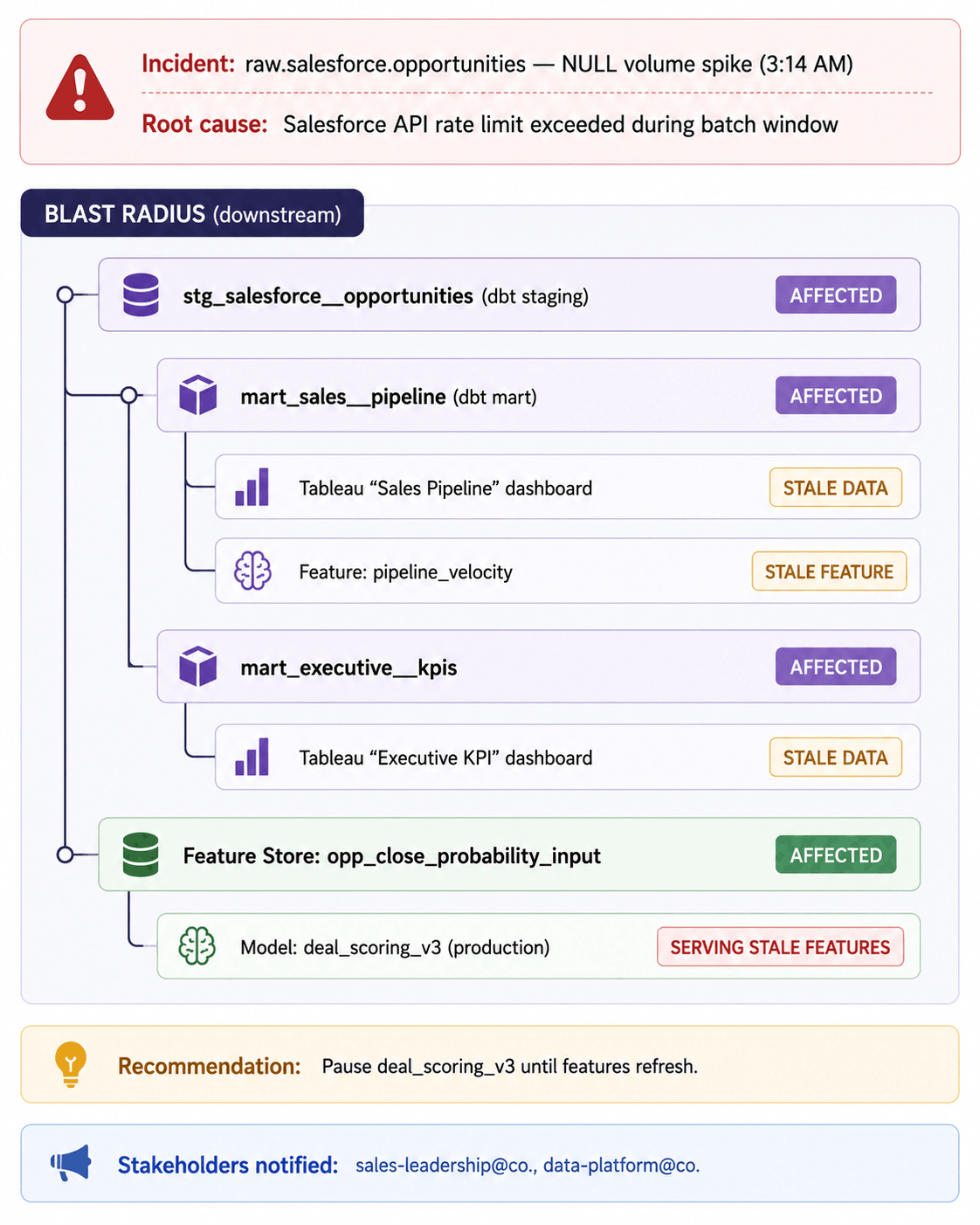
The blast radius report sample
Platforms: Monte Carlo, Acceldata, Bigeye (observability layer), OpenLineage (lineage events from dbt/Spark/Airflow), Databricks Unity Catalog lineage, Snowflake Horizon Context (column-level lineage).
Why orchestration matters here: A single observability agent detects the anomaly. Three coordinated agents deduplicate alerts, trace the root cause, and map the full blast radius in seconds — giving the on-call team a complete incident picture before they open their laptops.
Domain 7: Vector Data and RAG Pipelines — Managing the Agent Data Lifecycle
Production RAG systems are not one-time data loads. Documents change, embedding models are updated, and retrieval quality degrades as the corpus drifts from the embedding space the index was built on. This lifecycle requires coordinated agents.
A RAG lifecycle orchestration system: a Document Ingestion Agent (monitors source repositories for new and changed content, chunks, embeds, and upserts to the vector store); an Index Freshness Agent (detects stale chunks where the source has been updated but the index reflects old content); a Retrieval Quality Agent (runs a test set against the RAG pipeline, evaluating hit rate and mean reciprocal rank, diagnosing when quality drops whether due to embedding drift, chunking mismatch, or index bloat); and an Embedding Model Migration Agent (manages the re-embedding migration when a model upgrade is required — parallel quality testing, staged rollout, not a hard cutover).
Platforms: Databricks Vector Search, Snowflake Arctic Embed, Vertex AI Matching Engine, Pinecone, Weaviate, pgvector. All expose programmatic vector management APIs suited for agent-driven index lifecycle management.
Why orchestration matters here: A static RAG setup degrades silently as content changes and models evolve. A multi-agent lifecycle system maintains index freshness, monitors retrieval quality, and manages model migrations — treating the RAG index as a governed data asset rather than a one-time configuration.
Domain 8: The Long Tail — Data Workflows Agents Are Absorbing
Beyond the six primary domains above, agents are absorbing a long tail of specialized workflows that previously required dedicated expertise or bespoke automation:
Data contract management — monitoring contract compliance between producers and consumers, generating draft contracts for new consumer relationships, and triggering migration workflows on breaking changes. Tools: Soda, datacontract.com, dbt Contracts.
Schema migration agents — analyzing source DDL, generating target DDL with platform-specific syntax, identifying untranslatable stored procedure logic, and running regression tests against sample data. AWS Schema Conversion Tool with agent augmentation; custom LangGraph pipelines for Oracle/Teradata → Snowflake migrations.
Agentic reverse ETL — pushing warehouse-computed metrics back into operational systems (Salesforce, HubSpot), managing API rate limits, handling partial failures, and reconciling discrepancies. Census, Hightouch, and Reverse ETL platforms are adding agent-native sync configuration.
Catalog enrichment agents — profiling undocumented tables, generating business-readable descriptions from column names and sample data, suggesting classification tags, routing enriched entries for steward review. Alation, Ataccama, and Collibra all have catalog enrichment agents in 2026 — reducing documentation from a multi-year human project to a weeks-long automated exercise.
Synthetic data generation — consuming catalog schema and statistical profiles to generate privacy-preserving synthetic datasets for test environments, ML augmentation, and cross-org data sharing, with automatic regeneration when production schemas evolve. Gretel.ai, YData Synthetic.
Why orchestration matters here: Every workflow in this long tail is rule-intensive, context-dependent, and cross-system. Each one broke single-agent approaches for the same structural reasons: context exhaustion, no parallelism, and auditability collapse. Multi-agent orchestration solves them in bulk.
The Protocol Stack: How MCP and A2A Connect Agents to Data
Multi-agent data systems operate on two protocol layers — one connecting agents to tools, one connecting agents to each other:
MCP (Model Context Protocol) handles agent-to-tool communication. Every data system (Snowflake, Databricks, dbt Cloud, Airflow, Alation, Salesforce) exposes capabilities as MCP server tool sets. Agents call these tools through a governed, auditable layer without holding direct credentials to underlying systems. Snowflake's Natoma acquisition specifically targets MCP governance for agent tool access.
A2A (Agent-to-Agent Protocol) handles agent-to-agent communication. When an orchestrator delegates to a specialist, or when agents built on different frameworks exchange intermediate results, A2A provides the transport and identity layer — cross-vendor and cross-framework. A LangGraph orchestrator can delegate to a Vertex AI specialist; a Claude orchestrator can call an AutoGen sub-agent.
Together they form the infrastructure stack underneath all multi-agent data systems:
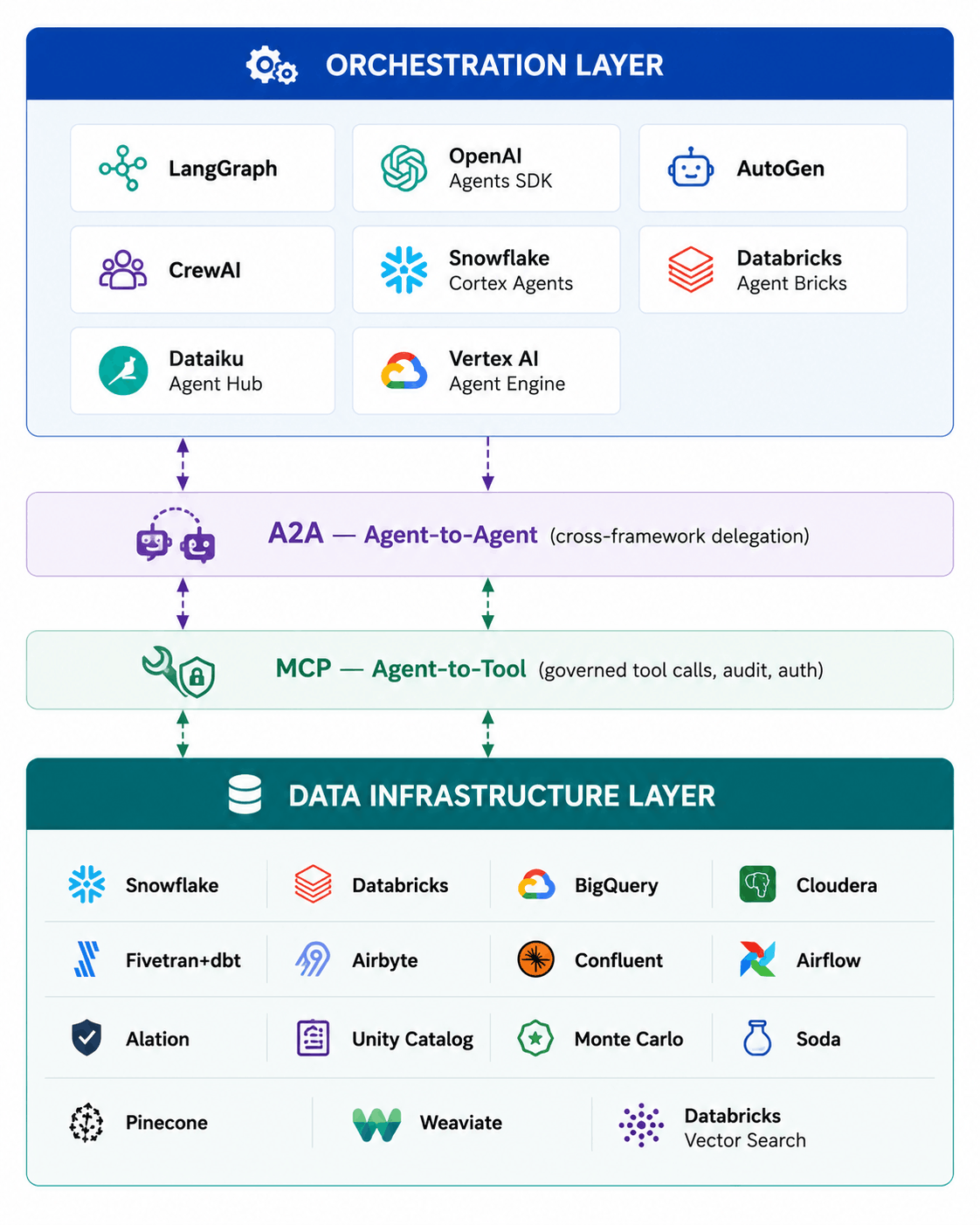
Multi data agent orchestration infra
Production Reality: Cost, Latency, and Human-in-the-Loop
Token Cost at Scale
Multi-agent systems are not free. A rough cost model for a mid-scale platform (500 tables, daily quality checks, 20 ingestion jobs):
| Agent Role | Est. Daily Tokens | Est. Daily Cost | Recommended Tier |
|---|---|---|---|
| Ingestion orchestrator (20 runs) | ~50K | ~$0.50 | Frontier model |
| Schema reconciliation | ~40K | ~$0.40 | Mid-tier |
| Quality anomaly detection (500 tables) | ~300K | ~$3.00 | Small/fast model |
| Governance classification (new assets) | ~20K | ~$0.20 | Mid-tier |
| Lineage documentation (on change) | ~10K | ~$0.10 | Mid-tier |
| Total | ~420K/day | ~$1,500/yr | — |
For a platform that previously required 2–3 hours of daily engineer time for manual quality triage and remediation (conservatively $80–$100/hour), the economics are straightforward. Use smaller, faster models (GPT-4o-mini, Claude Haiku, Gemini Flash) for narrow sub-tasks; reserve frontier models for the orchestrator and complex reasoning steps.
Latency
A 10-step sequential agent chain takes 30–90 seconds end-to-end. For data pipelines with minutes-to-hours freshness SLAs, this is acceptable. For real-time streaming with sub-second SLAs, agents belong in the control plane (deciding strategy, handling exceptions) — not the data plane (processing individual records).
Design principle: agents orchestrate, rules execute. Traditional rule-based automation handles the high-throughput steady state; agents handle the exceptions that require reasoning, escalation, or adaptation.
Human-in-the-Loop: Non-Negotiable Gates
Every production multi-agent data system must enforce human-in-the-loop checkpoints for:
- Any write to a certified production table or view
- Any change to data access policies or masking rules
- Any remediation touching a regulated or compliance-sensitive process
- Any schema change propagating downstream to certified datasets
These gates are not optional. The governance case for agentic data systems depends on the ability to audit and approve consequential actions. Systems that allow agents to autonomously modify production data will fail their first data governance audit — regardless of technical performance.
Frequently Asked Questions: Agentic Data Engineering
Q: What is agent orchestration in the context of data pipelines? Agent orchestration is the coordination of multiple specialized AI agents — each with a defined role, a scoped tool set, and its own context — under an orchestrator that decomposes tasks, routes to the right specialists, handles failures, and enforces human approval at critical gates. In a data pipeline, this means replacing a single LLM that tries to ingest, transform, validate, and govern all at once, with coordinated agents that each do one thing well.
Q: Is multi-agent orchestration better than a single LLM agent for data work? For simple, single-step tasks, one agent is sufficient and cheaper. For production data workflows — which are multi-step, cross-system, and require auditability — multi-agent orchestration is materially better. A single agent fails for four structural reasons: context window exhaustion under parallel load, no native parallelism, collapsed audit trails, and weaker performance when one model plays many specialized roles. Multi-agent systems decompose the work into specialists, run them in parallel (5–15× wall-clock improvement on parallelizable workloads), and produce attributable, auditable logs by design.
Q: What is the difference between MCP and A2A protocols? MCP (Model Context Protocol) handles agent-to-tool communication — how an agent reaches a database, API, or data platform through a governed, auditable layer without holding direct credentials. A2A (Agent-to-Agent Protocol) handles agent-to-agent communication — how an orchestrator delegates to a specialist, or how agents built on different frameworks exchange results. They are complementary layers: MCP connects agents to data systems; A2A connects agents to each other. Both are open standards as of 2026.
Q: How does multi-agent orchestration differ from Airflow or traditional data orchestration? Airflow orchestrates deterministic, code-defined tasks on a schedule. Agent orchestration handles tasks that require reasoning, judgment, and adaptation — schema changes that need classification, quality issues that need root cause diagnosis, governance decisions that need policy interpretation. The two are complementary: Prefect 3 and similar tools explicitly support agent tasks as first-class workflow steps alongside traditional code tasks.
Q: Should I use Snowflake Cortex Agents, Databricks Agent Bricks, or an external framework like LangGraph? It depends on your estate and governance maturity. If your data platform is single-vendor and you have an existing semantic layer and catalog, platform-native agents (Cortex Agents or Agent Bricks) give you faster time to production with governance inherited automatically. If your estate spans multiple platforms, or you need orchestration patterns the platform doesn't support, framework-based orchestration (LangGraph + MCP servers) gives you more flexibility. Most enterprises in 2026 run both. Dataiku Agent Management is worth evaluating if you need cross-platform governance regardless of where agents run.
Q: What is the most common reason agentic data deployments fail in production? Skipping the prerequisites. Agents querying ungoverned data without a semantic layer produce confident, wrong answers at machine speed. Agents using a data catalog that covers 20% of the estate can only govern 20% of what needs governing. The failure is not in the agent architecture — it is in the data foundation the agents are built on.
Q: What governance standards should agents comply with before accessing production data? At minimum: agents should carry verified identity (not delegated user credentials), operate with least-privilege tool access scoped to their role, have all tool calls logged with full payload audit trails, and be blocked from direct writes to certified production tables without human approval. Snowflake AI Agent Identity and Databricks Unity AI Gateway are the two most complete platform-native implementations of these requirements as of mid-2026.
What This Means for Data Teams in Practice
The shift from "I have an AI assistant" to "I have an AI-operated data system" is an operational model change, not a technology change. The data engineer's role moves up a level: instead of manually investigating quality incidents, the engineer reviews the agent's diagnosis and approves the proposed remediation. Instead of writing dbt models from scratch, the engineer reviews the agent's generated model and approves the PR. Instead of manually classifying every new table, the data steward reviews classification proposals in batches and builds the feedback loop that improves accuracy over time.
The total amount of governance work may not decrease — but throughput increases, and coverage extends to the long tail of data assets that were previously ungoverned because there was not enough human bandwidth to reach them.
Every major data platform has made its platform positioning bet: Snowflake as the governed agentic perimeter, Databricks as the open governance layer that travels with every agent, Dataiku as the cross-platform orchestration control plane. The Fivetran + dbt Labs merger signals that even the ingestion-to-transformation stack is now being designed as agent infrastructure.
The organizations building this architecture now — not piloting a single agent, but designing the orchestration layer, the human-in-the-loop gates, and the semantic layer that makes outputs trustworthy — are the ones whose data teams will operate at materially higher scale in 2027.
Work With DataMy: Building Your Agentic Data Architecture
DataMy works with data and AI leaders across APAC on the full stack from platform selection to agentic workflow deployment:
- Agentic Architecture Design — which domains to automate first, which frameworks fit your stack, where to enforce human-in-the-loop gates for governance compliance
- MCP + A2A Integration — connecting your data infrastructure (Snowflake, Databricks, dbt Cloud, Alation, Airflow) to MCP servers and designing A2A delegation patterns
- Data Quality Automation — implementing the three-agent quality system on your existing observability tooling
- Semantic Layer as Agent Foundation — dbt MetricFlow, Snowflake Semantic Views, or Databricks AI/BI Genie as the context layer that makes agent SQL trustworthy
- Governance Agent Deployment — agentic classification, policy enforcement, and stewardship routing on your catalog platform
Contact: [email protected] · Website: datamy.co