Why AI Agent Memory Is a Data Architecture Problem in 2026
TL;DR — In 2026 "AI memory" went from a niche toggle to a headline feature across the entire industry. OpenAI shipped background memory curation ("Dreaming"), Google turned Gemini's chat history into persistent "memories," Microsoft added Copilot Memory with admin governance, and Anthropic gave Claude file-based memory. Behind them, a startup category formed — Mem0, Zep, Letta, LangMem — and Stanford spinout Engram raised $98M to bake company knowledge straight into model weights. Yet the numbers expose the catch: a leading memory system scoring ~92% on the LoCoMo benchmark delivers only ~49% effective accuracy in production after 30 days (per the vendor's own reporting), once facts go stale and contradict each other. The hard problem was never recall — it is keeping recalled knowledge fresh, traceable, and governed as the business changes underneath it. That makes agent memory a data architecture problem before it is a model problem. This piece covers what "memory" actually means (it's at least three different things), why the benchmark-to-production gap exists, how RAG vs fine-tuning trade off, where weight-baked memory breaks under PDPA and MAS, and what data leaders should build now.
There is a particular kind of AI claim that sounds like magic and turns out to be plumbing. "Give your agent memory" is one of them. For two years the phrase was sold as a model capability — a longer context window, a "memory" toggle, a better recall score. In 2026 that framing broke, and it broke across the whole market at once.
Consider how crowded the field got in a single window. Between early 2024 and mid-2026, ChatGPT, Claude, and Gemini all shifted from stateless chatbots to systems that retain long-term context by default. OpenAI announced "Dreaming" on 4 June 2026 — background curation that quietly rewrites your memory over time (revising "going to Singapore" to "went to Singapore" after the trip). Google renamed Gemini's past chats to "memories" and rolled persistent history across Workspace. Microsoft shipped Copilot Memory with a "memory updated" signal and admin-level governance controls. Anthropic took the opposite design stance — human-readable markdown memory files an agent reads on demand. Underneath the model vendors, a dedicated startup layer emerged: Mem0 (a $24M Series A and 48,000+ GitHub stars), Zep, Letta (the production heir to MemGPT), and LangMem (LangChain's memory SDK). And at the frontier, eight-month-old Engram left stealth on 23 June 2026 with $98M (co-led by General Catalyst) to do the most radical version of all: dissolve a company's knowledge directly into model weights so an agent "just knows," instead of re-reading files.
That is not one startup making a claim. That is an entire industry deciding, simultaneously, that memory is the next battleground. Which makes the second data point far more interesting than any funding round: Mem0's own production reporting — a vendor figure, but a striking one to publish against your own benchmark — found that a system scoring ~92% on the standard LoCoMo benchmark delivered roughly 49% effective accuracy after 30 days across 50,000 sessions, once real-world staleness (~38%) and contradicting facts entered the store. Read the digits with the usual vendor caution; the direction is corroborated by every rival independently shipping anti-staleness features (below).
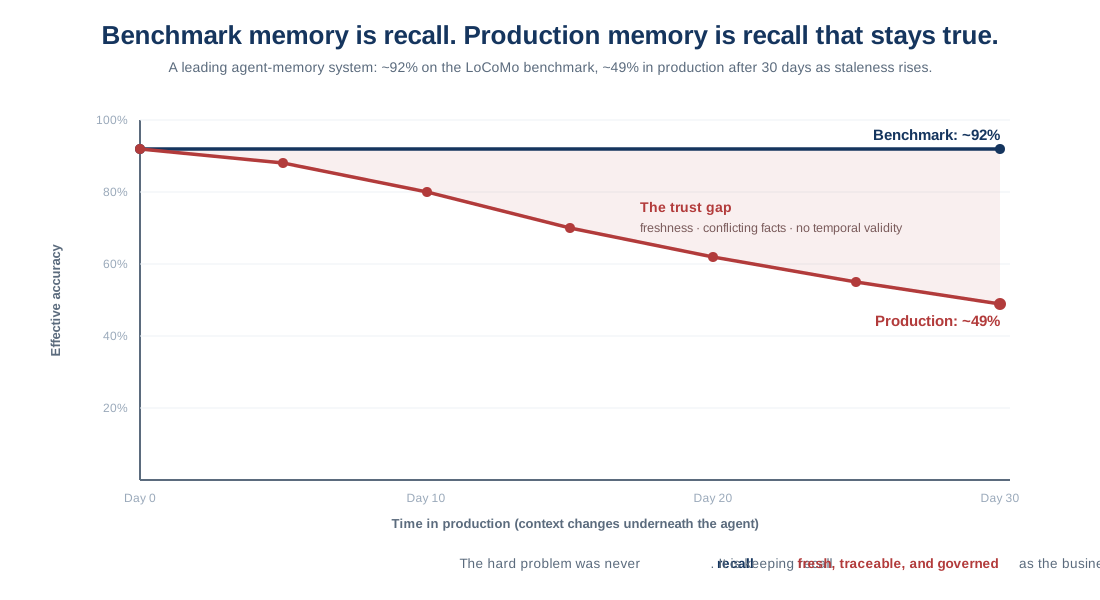
A leading agent-memory system scores ~92% on the LoCoMo benchmark but ~49% in production after 30 days, as staleness and contradictions accumulate. The benchmark tests whether a system can retrieve a fact it was told — not whether that fact is still true.
Put the crowded market and that collapse side by side and the real question of enterprise AI memory comes into focus. It is not "can the agent remember?" Everyone's agent remembers fine now. It is "can it keep what it remembers true, attributable, and inside policy as the business changes?" That is not a model question. It is a data architecture question — about catalogs, semantic definitions, lineage, retrieval boundaries, and governance. Better models do not fix bad memory architecture. They just spend more confidently on top of it.
"Memory" is at least three different things
Half the confusion is linguistic. Model vendors, memory startups, and researchers all say "memory" and mean different mechanisms. Collapse them into one word and you make bad architecture decisions — storing workflow state in a vector index, or trying to govern a metric definition with a session cache.
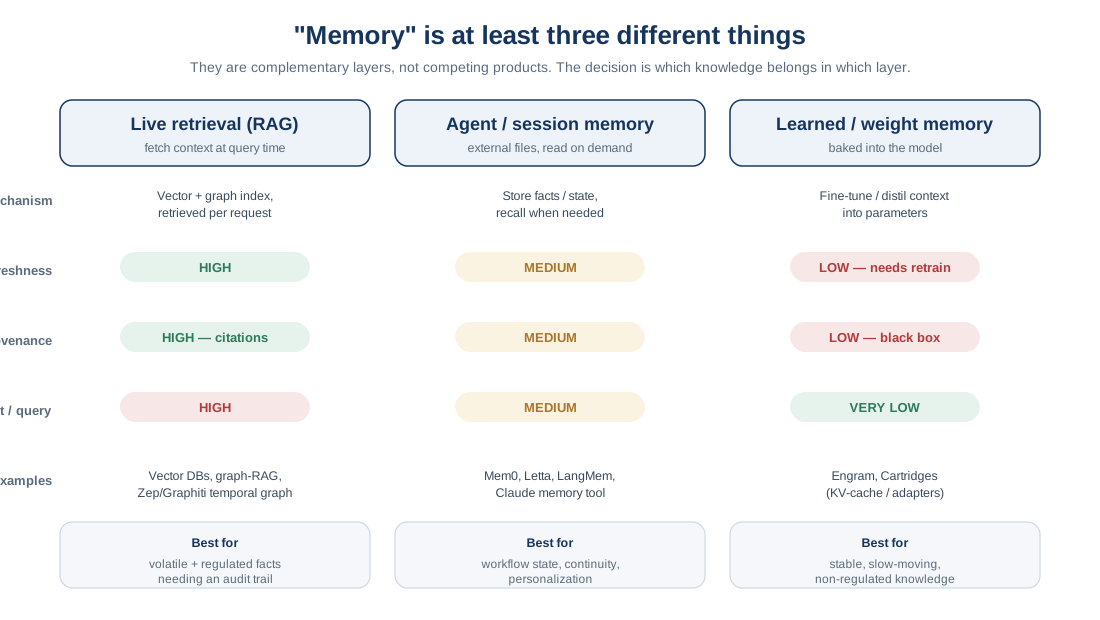
Three complementary layers, not competing products. Live retrieval is fresh and auditable but costly per query; agent memory carries workflow state; learned memory is cheap to reuse but stale and unattributable. The decision is which knowledge belongs in which layer.
| Memory layer | What it actually is | Where it lives | Representative |
|---|---|---|---|
| Agent / session memory | Preferences, task state, interaction history, "what I already checked" | External store, read on demand | Mem0, Zep, Letta, LangMem; Anthropic's memory tool; Copilot Memory |
| Enterprise knowledge memory | Shared company knowledge, terminology, decisions, evolving internal context | Learned/compressed layer, reused across queries | Engram's "learned memory"; the Cartridges method |
| Model-architecture memory | Pattern lookup baked into weights at train time | Inside the model | Adapter fine-tuning, KV-cache distillation |
These are complementary, not competing — a mature system uses all three, with explicit rules about what flows where. The mistake is treating a choice between them as if it settled an architecture. Zep and Mem0 are not really competing with Engram; they occupy different layers with different freshness and provenance profiles.
The benchmark trap: 92% in the lab, 49% on a Tuesday
Memory is now a first-class research field with its own leaderboards. LoCoMo strings together conversations averaging ~300 turns and ~9,000 tokens across up to 35 sessions; LongMemEval stresses long-horizon recall. Mem0, one of the stronger systems, posts around 91–92% on LoCoMo and 93–94% on LongMemEval at roughly 6,900 tokens per query — genuinely good engineering, and reported (in Mem0's own benchmarking) to beat OpenAI's built-in memory by ~26% on the same tasks.
The benchmarks measure the wrong half of the problem. They test whether a system can retrieve a fact it was told. They do not test what happens when that fact is superseded, contradicted by another source, or simply goes stale — which is the normal condition of every enterprise. That is why the same class of system that scores ~92% in a controlled benchmark degrades to ~49% effective accuracy after 30 days in the vendor's own production reporting, once contradictions and decay enter. The diagnosis is precise: vector-similarity retrieval can tell you what a fact says, but temporal queries require knowing when a fact was valid — and without temporal modeling, no extraction pipeline stops stale data from accumulating.
You can see the whole industry reacting to exactly this failure. OpenAI's "Dreaming" is, at heart, an attempt to keep memory fresh by rewriting entries in the background. Zep built its entire differentiation — a temporal knowledge graph called Graphiti — around tracking how facts change over time rather than just storing them. When the market's leaders are independently shipping features to fight staleness, staleness is not a startup's talking point. It is the defining problem.
Benchmark memory is recall. Production memory is recall that is still true a month later. The gap between them is not a model defect — it is the absence of a data architecture that manages freshness, provenance, and conflict.
Why "learning from your workspace" is harder than it sounds
Engram's underlying research is real and clever. Its CTO, Sabri Eyuboglu, co-authored Cartridges (Stanford, 2025): instead of dumping a 70,000-word corpus into context — which can inflate the KV cache into 100+ GB of GPU memory — you train a small reusable KV cache offline via "self-study," cutting cache memory by an average 39× while holding quality. Engram industrialises that idea into per-team models that internalise a company's documents and workflows.
Its headline pitch — answering in ~100 tokens what a frontier model burns ~100,000 tokens doing, i.e. up to 100× fewer tokens — is worth stating plainly as an unverified vendor claim. As of mid-2026 it has not been confirmed by any independent benchmarking body; the figure comes from Engram's own materials and is corroborated only by commercial partners (Notion, Harvey, Microsoft) who have a financial relationship with the company. The cost logic is sound — re-reading the same institutional context on every request is genuinely wasteful — but the multiplier is a marketing number until someone neutral publishes.
More importantly, the moment knowledge moves from retrieved to learned, four problems get harder at once — and now there is evidence for each:
- Freshness. Enterprise context changes constantly. RAG just updates an index and the next query sees the new fact; weight-baked knowledge needs a new fine-tuning job per change. The 92%→49% production collapse is this problem made measurable.
- Forgetting. Continual fine-tuning is prone to catastrophic forgetting — 2025 studies document prior-task knowledge dropping to as low as 26% after narrow fine-tuning, with safety alignment especially fragile. Memory that improves this week's task while silently breaking last quarter's is a liability, not an asset.
- Traceability. Retrieval gives you an audit trail for free — the retrieved passage is the citation. Once knowledge is dissolved into weights, "where did this answer come from?" becomes unanswerable. In regulated workflows that gap is disqualifying.
- Governance. Some context should be retrieved live, some held as short-lived state, some retained as durable memory, and some never absorbed at all. Without explicit boundaries, both memory quality and control degrade together.
RAG vs fine-tuning: which knowledge belongs in which layer
This is why the realistic enterprise future is hybrid memory, not one winning method. The RAG-vs-fine-tuning debate is a false binary — each earns a different slice of your knowledge:
| Approach | Mechanism | Freshness | Provenance | Token cost | Best for |
|---|---|---|---|---|---|
| Live retrieval (RAG) | Query-time vector + graph index | High | High (citations) | High per query | Volatile facts, regulated answers needing audit |
| Agent / session memory | External memory files, read on demand | Medium | Medium | Medium | Workflow state, personalization, continuity |
| Learned / weight memory | Adapter fine-tuning, KV distillation | Low | Low | Very low per query | Stable, slow-moving institutional knowledge |
The architecture decision is not "which one." It is which slice of our knowledge belongs in which layer — and who is accountable for that mapping.
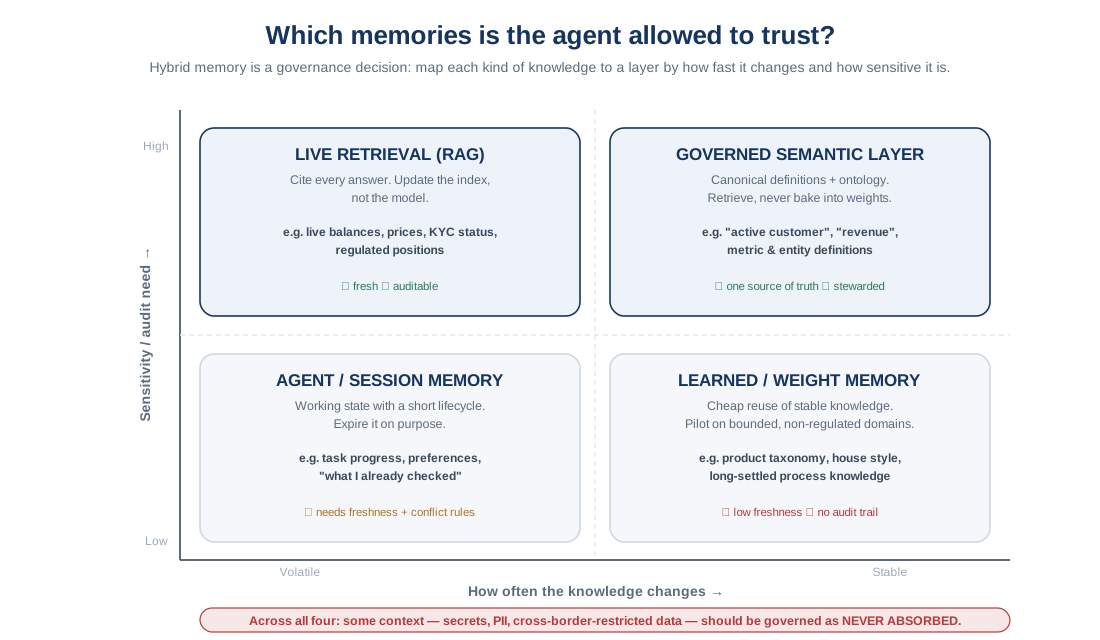
Hybrid memory is a governance decision. Map each kind of knowledge to a layer by how fast it changes and how sensitive it is — and treat some context (secrets, PII, cross-border-restricted data) as never-absorbed across all four.
Data for dashboards is not data for agent memory
Most enterprise data was structured for a human reading a chart: pre-aggregated, visually arranged, with the analyst's judgment quietly supplying the missing context. Agent memory needs the opposite — context structured for retrieval, action, continuity, and policy-aware reuse.
A metric defined well enough for a human to interpret on a Friday review is usually defined too loosely for an agent to act on autonomously on a Monday. The human silently resolves the ambiguity the dashboard left open — "active customer," "revenue net of refunds," "receivable at risk." The agent cannot. It either has the relationship made explicit, or it invents one. That is the same lesson the ontology shift taught: more context does not resolve a definitional conflict; it just includes both versions of it. (We unpacked this in The Ontology Renaissance — memory without semantic structure remembers facts while misunderstanding the business.)
If retrieval gives an agent access to content, and ontology gives it a map of what that content means, then governance decides which memories the agent is allowed to trust — and that is the layer most teams haven't built.
What actually becomes "memory" in an enterprise system
In production, agent memory is assembled from several governed stores at request time, not pulled from one place. Separating the layers makes the architecture tractable:
- Interaction memory — what was said, asked, decided.
- Workflow memory — where a multi-step process stands; what ran, what's pending.
- Business context memory — terminology, definitions, relationships, the organization's evolving reality.
- Data asset memory — what data exists, what it means, how fresh it is, where it came from.
- Policy & permission memory — who may see what, what needs approval, what must never be retained.
Each maps to infrastructure data teams already own or should: metadata, catalogs, semantic definitions, lineage, logs, execution traces, human approvals. Memory, seen this way, is less a model capability than a composition of governed sources — which is precisely why it lands on the data team's desk, not the ML team's. (This is the same six-layer foundation covered in What a Modern Data Platform Architecture Must Include in 2026.)
The market is converging on memory scaffolding
The design choices across vendors are revealing. Anthropic's memory tool (Managed Agents memory hit public beta on 23 April 2026) stores memories as files an agent reads on demand — "just-in-time" retrieval — paired with context editing (pruning stale context) and compaction (server-side summarisation near the window limit). OpenAI leans on background curation. Zep leans on a temporal graph. Microsoft leans on admin governance controls. Different bets, one direction: structured, governed, inspectable memory artifacts — the deliberate opposite of one-shot prompting. Rakuten, an early adopter of Anthropic's file-based memory, reports 97% fewer first-pass errors on long-running task agents (alongside a 27% cost reduction and 34% latency improvement), while Netflix uses the same memory to carry context and human corrections across sessions and Wisedocs reports 30% faster document verification. These are Anthropic-published customer figures — vendor-reported, not independently audited — but directionally consistent with the "structured beats opaque" pattern.
The through-line across every one of these — model vendor and startup alike — is that memory is being pulled out of the opaque model and into an inspectable, governable layer. That is a data-architecture instinct, whether or not the vendors call it that. (The reach into those source systems is itself an integration problem — see MCP and Enterprise Data Integration for AI Agents.)
Failure modes when memory is treated as a model feature
When memory is bolted on as a setting rather than designed as architecture, the failures are predictable — and most are not model failures wearing a model's face:
- Agents act confidently on stale facts (the 49% problem).
- Agents retrieve the wrong source of truth among several plausible ones.
- Two agents apply two different definitions of the same metric.
- Memory volume grows while trust falls.
- No one can explain why the agent recommended what it did.
- Sensitive context is retained longer than policy intended.
- Learned context drifts from documented reality between fine-tuning runs.
What this means for APAC enterprises — where weight-baked memory hits a wall
The vendor race is framed in Silicon Valley cost terms: fewer tokens, lower latency. For data leaders in Singapore and across APAC, dissolving company knowledge into model weights collides with a stricter reality.
- Provenance is a compliance requirement, not a nice-to-have. The MAS Data Governance Guidelines (Feb 2024) expect CDO accountability and auditable lineage for how data definitions are set and used; MAS TRM (2021) requires immutable audit trails for any action that reads, writes, or transforms regulated data — all aligned with BCBS 239. Retrieval-based memory produces that audit trail natively. Weight-baked memory erases it: you cannot cite a fact that has been dissolved into parameters. For MAS-regulated FSI, that is close to a hard stop for the learned-memory layer on regulated workflows.
- "What gets absorbed" is a data-residency question. Engram-class approaches internalise documents, workflows, and communications. Under PDPA — and for institutions with Greater China operations facing cross-border constraints — a memory layer that ingests across operational and communication systems raises immediate questions of classification, residency, and cross-border flow. The scope of what is learned must be governed deliberately, not left to "absorb everything." Microsoft building Copilot Memory with admin-level governance controls is a tell: even the personal-productivity layer needed a policy surface before enterprises would switch it on.
- "Whose definition wins" becomes an audited decision. When an agent's memory encodes that "active customer" means X, that is automated metric stewardship — and it must be human-reviewable and traceable, not a silent artifact of last month's fine-tune.
- A pragmatic sequence for the APAC mid-market. Most mid-market enterprises here lack the bench strength to govern a learned-memory layer in production. The sensible order: (1) stand up a governed semantic layer and catalog so definitions are explicit and lineage exists; (2) keep volatile and regulated knowledge in live retrieval with citations; (3) pilot learned/compressed memory only on stable, non-regulated, bounded domains; (4) insist on audit and freshness SLAs before any agent trusts memory in a regulated flow. Adopt the efficiency — but earn the trust incrementally, the way the regulator will expect.
What data teams should do next
- Map which contexts actually need to persist. Not everything deserves memory; most context should expire.
- Separate working memory from durable memory. Session state and institutional knowledge have different lifecycles, owners, and governance needs — stop storing them the same way.
- Treat memory quality as data quality. Stale or ambiguous memory is a data-quality defect with a new blast radius. Give it freshness SLAs and conflict-resolution rules.
- Decide per context: retrieve, summarise, store, or learn. "Retrieve everything, every time" is a cost and governance problem in disguise; "learn everything into weights" is a provenance problem in disguise.
- Put memory design into platform and AI architecture planning as a first-class requirement, not a late add-on — alongside the catalog, semantic layer, lineage, and observability you already need.
The bottom line
The funding rounds say the market believes memory is the next frontier. The 92%-to-49% collapse says the frontier is governance, not recall. Both are right. In enterprise AI, memory is becoming a data architecture problem because useful memory depends on how context is modeled, governed, retrieved, structured, and kept true — not on model intelligence alone.
The future is almost certainly hybrid: retrieval for freshness and citation, agent state for workflow and continuity, learned memory for the stable knowledge that rarely changes, ontology-backed semantics for meaning, and governance deciding which memories an agent is allowed to trust. The teams treating memory as a model setting will keep paying to re-read the same context while their agents quietly drift from reality. The teams treating it as architecture will decide — deliberately, and auditably — what their agents remember, and why.
The question for any data leader in 2026 is no longer "which model remembers best?" It is: who governs what your agents are allowed to believe — you, or your vendor's fine-tuning run?
Where DataMy fits
Memory is moving from a model feature to an architecture decision — and in APAC, the cost of getting it wrong (a confidently stale or unattributable answer in a regulated workflow) is higher than almost anywhere. DataMy helps enterprises across Singapore and APAC:
- Agent-memory architecture review — map which contexts your agents need to remember, separate working from durable memory, and assess whether your metadata, lineage, and semantic definitions are strong enough to support autonomous action.
- Retrieve-vs-learn evaluation — vendor-neutral assessment across live retrieval, agent-memory frameworks (Mem0 / Zep / Letta / LangMem-class), model-vendor memory (OpenAI, Google, Microsoft, Anthropic), and learned-memory approaches (Engram / Cartridges-class), scored against your freshness, provenance, and PDPA/MAS profile — not a launch benchmark.
- Governed implementation — semantic layer, catalog, retrieval boundaries, and audit/lineage built in from day one, so memory quality is enforced as part of data quality.
If your agents are about to act on what they remember, make sure someone governs what they're allowed to believe. → Talk to us at [email protected].
FAQ
What is agent memory in enterprise AI? The context an agent carries across tasks and sessions — interaction history, workflow state, business definitions, data-asset knowledge, and policy constraints — assembled from multiple governed stores rather than held purely inside the model. It comes in three distinct forms: session memory (external, read on demand), enterprise knowledge memory (learned/compressed), and model-architecture memory (baked into weights).
Why do agent-memory systems score high on benchmarks but fail in production? Benchmarks like LoCoMo test whether a system can retrieve a fact it was told. They don't test what happens when that fact is superseded, contradicted, or goes stale. Mem0's own production reporting found a leading system scoring ~92% on LoCoMo but ~49% effective accuracy after 30 days, because vector-similarity retrieval knows what a fact says but not when it was valid. The gap is freshness and conflict management, not retrieval.
RAG vs fine-tuning for enterprise memory — which should I use? Both, for different knowledge. RAG keeps volatile and regulated facts current and citable (update the index, no retraining; the retrieved passage is your audit trail). Fine-tuning / learned memory cuts token cost for stable, slow-moving institutional knowledge but sacrifices freshness and provenance. Hybrid is the 2026 default.
Which vendors offer AI agent memory in 2026? Model vendors: OpenAI (ChatGPT memory + "Dreaming" background curation), Google (Gemini "memories"), Microsoft (Copilot Memory), Anthropic (Claude file-based memory tool). Dedicated frameworks: Mem0, Zep (Graphiti temporal graph), Letta, LangMem. Learned-memory frontier: Engram (based on the Cartridges method). They occupy different architectural layers, not one shared category.
Why is learned (weight-baked) memory risky for regulated industries? Once knowledge is dissolved into model weights, you cannot cite where an answer came from, and updating a fact requires a new fine-tuning job. That breaks the auditable lineage MAS Data Governance Guidelines (2024) expect and the immutable audit trails MAS TRM (2021) requires. For MAS-regulated workflows, keep regulated knowledge in live retrieval.
What data architecture components support reliable agent memory? A data catalog, semantic layer, ontology/business model, documentation, lineage and provenance, a retrieval/vector strategy, access-control boundaries, and observability with trace logs — treated as memory components with freshness SLAs and conflict-resolution rules, not just governance hygiene.
Sources
Market / primary:
- Engram exits stealth with $98M — CNBC, PRNewswire, Dealroom
- Engram 100× token-cut claim (unverified vendor figure) — TechTimes, AI Insiders
- OpenAI "Dreaming", Gemini "memories", Copilot Memory, Claude memory — AI Memory Compared 2026 — MemoryLake, Gemini persistent memory in Workspace — WebProNews
- Anthropic memory tool & Managed Agents memory (public beta, 23 Apr 2026) — Claude Platform Docs — Memory tool, Effective context engineering for AI agents — Anthropic
Benchmarks / research:
- Mem0 LoCoMo / LongMemEval results, +26% vs OpenAI, and the production-accuracy gap (~49% after 30 days at ~38% staleness) — all figures from Mem0's own reporting — Mem0 — State of AI Agent Memory 2026, Mem0 — AI Memory Benchmarks 2026, Long-Term Memory for AI Agents: Production 2026
- Mem0 paper — arXiv:2504.19413
- Zep / Graphiti temporal knowledge graph; Letta, LangMem landscape — Agent Memory at Scale 2026 — AgentMarketCap, AI Agent Memory Systems Guide 2026
- Cartridges: long-context representations via self-study (39× KV-cache reduction) — arXiv:2506.06266, Hazy Research / Stanford blog
- Catastrophic forgetting in continual fine-tuning (knowledge drops to ~26%) — arXiv:2308.08747, MIT fine-tuning without forgetting — VentureBeat
- RAG vs fine-tuning — freshness & provenance trade-offs — Glean — RAG vs fine-tuning, RAG vs Fine-Tuning: 2026 Decision Guide
- Rakuten 97% first-pass error reduction (+27% cost, +34% latency); Netflix context continuity; Wisedocs 30% faster verification — Anthropic-published customer figures, not independently audited — Built-in memory for Claude Managed Agents, Rakuten case study
Regulatory (APAC):
- MAS Data Governance Guidelines (Feb 2024); MAS TRM Guidelines (Jan 2021); Singapore PDPA; BCBS 239.
Related reading
- The Ontology Renaissance: Why a Decades-Old Discipline Now Powers AI — the semantic backbone memory needs; why meaning isn't measurement.
- What a Modern Data Platform Architecture Must Include in 2026 — the six-layer platform, semantic layer, and APAC governance context.
- MCP and Enterprise Data Integration for AI Agents — how agents reach the systems whose context becomes memory.