The AI revolution hinges on three pillars: computing power, models, and data. While computing power (driven by GPUs) and models (like large language models, or LLMs) are increasingly commoditized and accessible via third-party providers, data remains the unique differentiator for businesses. Whether it’s customer interactions, product documentation, financial records, or unstructured content like PDFs and images, data is the lifeblood of AI systems. Yet, traditional data architectures—designed for legacy analytics and transactional systems—are ill-equipped to meet the demands of AI and autonomous agents. Here’s how to future-proof your strategy.
Why Traditional Architectures Fall Short for AI Systems
Traditional data architectures, often built around rigid schemas, APIs, and BI tools, struggle to meet the complex demands of AI systems. These systems are often:
- Not designed for dynamic interactions, which are essential for conversational AI and autonomous agents.
- Primarily built for retrospective analysis rather than predictive or generative tasks that AI excels at.
- Lacking in support for embeddings, semantic understanding, and seamless integration with LLMs.
- Siloed, making it difficult for AI systems or agents to access the breadth of information they need.
AI and autonomous agents require data architectures that can:
- Handle unstructured data at scale (text, images, audio, video), which makes up a significant portion of business data.
- Enable real-time context retrieval for tasks like answering customer queries with up-to-date information and responding to changes in the environment.
- Reduce LLM hallucinations by grounding responses in reliable, verified data sources.
- Support multi-modal inputs and outputs, allowing agents to interact with a range of information formats.
- Adapt to changing information and learn from new data. Without these capabilities, businesses risk deploying AI systems that are inaccurate, slow, or limited in their usefulness.
Building an AI-Ready Data Architecture
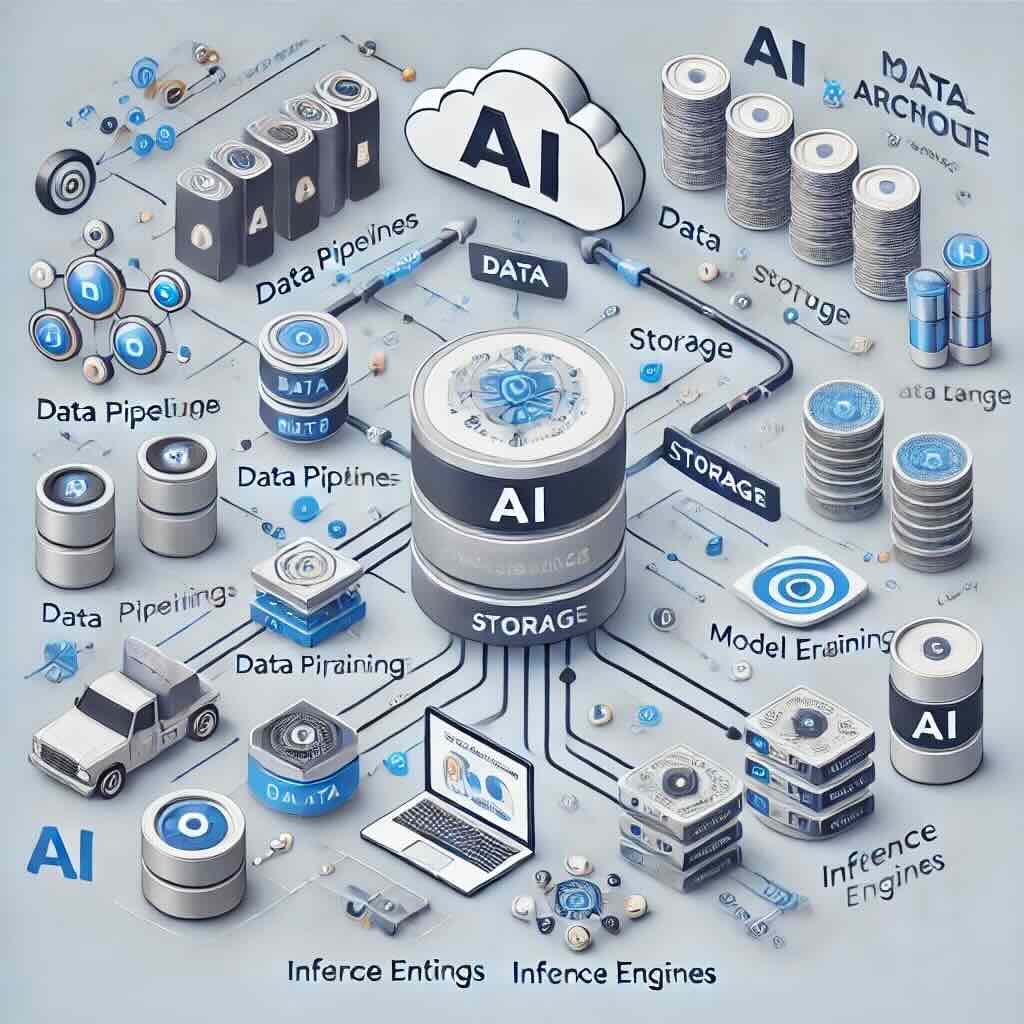
To empower AI agents and LLMs, modern data architectures must prioritize contextual understanding, semantic flexibility, and real-time adaptability. Key components include:
1. LLM Compatibility
- Unified Data repository: Consolidate structured and unstructured data into a single repository with metadata tagging for easier LLM access. This unified approach is crucial, as foundation models benefit from diverse data. Data repository must be designed to handle the various formats that AI systems will encounter.Large enterprise data repositories are often built on top of a data lake architecture.
- Schema Agnosticism: Move beyond rigid schemas to enable AI models to interpret raw data dynamically. This flexibility is essential as AI must be able to process a wide variety of inputs, such as parsing a PDF invoice without predefined templates.
2. Semantic Search & Vectorization
- Embedding Models: Utilize embedding models (e.g., OpenAI’s text-embedding-3) to transform text, images, or tables into vectors for LLM-friendly analysis. Vector embeddings, which capture the semantic meaning of data, are critical for effective AI processing.
- Vector Databases: Implement vector databases for efficient storage and retrieval of vector embeddings.There are various vector databases available, including:Pinecone, Milvus, AstraDB, Chroma, and more.
- Semantic Understanding: Implement semantic search capabilities to allow AI to understand the meaning behind the data, not just keywords. This advanced search is important for AI to extract the most relevant information from data stores, improving response quality.
3. Real-Time Data Pipelines
- Dynamic Data Pipelines: Support real-time data ingestion (e.g., IoT sensors, chat logs) to ensure AI agents have access to the most current information. This is crucial for applications that require timely responses and actions.
- Multi-Source Integration: Link internal databases, third-party APIs, and public datasets to give agents a 360-degree view. Access to varied data sources can significantly improve an agent’s understanding and decision-making. Data integration across diverse modalities like text, video, and sensor data will become increasingly important.
4. AI Agent-Centric Design
- Governance & Versioning: Track data lineage, access permissions, and model training datasets to ensure compliance and auditability. This is vital for maintaining transparency, trust, and accountability, and for adhering to regulatory requirements.
- Data Minimization: Implement practices to use only the data necessary for a particular task to enhance privacy and efficiency.
- Tools: Agents use tools to interact with the world, extending their capabilities.
- Extensions: Bridge the gap between an agent and external APIs. They enable agents to interact with external services by teaching the agent how to use the API with examples.
- Functions: Provide developers fine-grained control over data flow and system execution. Functions enable agents to perform specific operations, such as sending an email or making an API call.
- Data Stores: Give agents access to both structured and unstructured data. Data stores are often implemented as vector databases and are crucial for RAG (Retrieval Augmented Generation) applications. Just a few days after Deepseek's release of its new model, OpenAI has announced its Operator framework, which allows developers to build agents that can interact with external tools and data sources. We expect to see more companies in LLM space to delve into the agent tooling space.
5. Model Training and Adaptation
- Targeted Learning: Enhance model performance by training the models to choose the right tools when generating output. This involves providing examples that demonstrate the agent's capabilities and how it uses specific tools.
- Adaptation: Foundation models are intermediary assets and must be adapted for specific downstream tasks, domains, and to reflect changes in the world.
- Fine-tuning is a common approach to adaptation, but other lightweight methods exist.
- Prompting-based methods can also be used for adaptation.
- Adaptation can also involve the introduction of constraints such as data privacy compliance.
- Continual Learning: Implement methods to allow AI models to learn from new data, without having to retrain from scratch.
6. AI Safety and Alignment
- Implement measures to ensure that the AI models are safe and aligned with human values.
- Address the misalignment between a model's training objective and desired behaviors.
Overcoming Transition Challenges
Shifting to an AI-ready architecture involves several challenges:
- Legacy System Integration: Modernizing legacy systems requires a gradual approach, using middleware or hybrid cloud solutions. This process often requires careful planning and execution, and may involve dealing with siloed and outdated systems.
- Cost vs. Performance: Balancing the expense of vector databases, GPU-powered pipelines, and other AI infrastructure with the return on investment from AI use cases is crucial. Optimizing for both cost and performance is necessary for scaling AI applications.
- Skill Gaps: Upskilling teams in areas like embedding techniques, LLM fine-tuning, semantic search optimization, and AI safety is necessary to effectively implement and manage these systems. This may require specialized training and hiring.
- Data Quality: Ensuring high-quality training data is critical. Data needs to be relevant, unbiased, and representative of the real world.
The Future Belongs to Data-First Organizations
As AI agents evolve from chatbots to autonomous decision-makers, businesses with robust, well-managed data architectures will have a competitive edge. By prioritizing unified storage, semantic search, real-time data pipelines, and responsible AI practices, organizations can transform their data into a strategic asset.
Start today:
- Audit your data pipelines for LLM compatibility. Ensure data can be accessed by LLMs and can be processed efficiently.
- Pilot a RAG-based application to understand how agents can leverage external data. RAG allows models to extend their knowledge by accessing information in data stores, improving accuracy and relevance.
- Rethink storage strategies around vectors, not just tables.
- Consider Ethical Frameworks when designing, implementing, and deploying AI systems. Ensure transparency, fairness, and freedom from bias.
- Focus on Data Quality through proper curation and management of datasets.
- Implement safety measures to prevent potential accidents, hazards, and risks of advanced AI models.
- Use AI-driven tools to improve the speed and accuracy of data analysis.
- Embrace an iterative approach to development and deployment of agents.
The AI era rewards those who treat data as the foundation of innovation. By building robust data architectures, businesses can unlock the full potential of AI and stay competitive in the rapidly evolving technological landscape.
References
- Jared Kaplan, Sam McCandlish, and Tom Henighan, et al. 2020. Scaling Laws for Neural Language Models.
- Rishi Bommasani, Drew A. Hudson, and Ehsan Adeli, et al. 2022. On the Opportunities and Risks of Foundation Models.
- Jai Vipra and Sarah Myers West. 2023. Computational Power and AI.
- Julia Wiesinger, Patrick Marlow and Vladimir Vuskovic. 2024. Agents
- Proserveit. 2024. AI for Data Analytics: Faster Insights, Automation, and Strategic Growth.
- European Commission. 2020. On Artificial Intelligence: A European Approach to Excellence and Trust.