Across Singapore and the broader ASEAN market, many small businesses are still running core operations through a mix of CRM, ERP, spreadsheets, messaging tools, and ad hoc reporting. Meanwhile, mid-sized enterprises have often layered in BI and integration tools without truly connecting workflows end to end. The result is familiar: leaders have more systems, yet less confidence in the consistency, timeliness, and actionability of the data flowing through them.
This is why the next phase of transformation needs a sharper point of view. Modernization should not be framed as a technology shopping exercise. It should be treated as a business architecture decision: how to create a modular, cloud-based data foundation that improves commercial visibility today and supports automation and AI tomorrow.
Why the Old Playbook is Breaking
In many growing companies, each department adopted the tools it needed at the time. Sales wanted pipeline visibility, finance needed reporting discipline, operations needed workflow control, and management needed dashboards. That brought short-term progress, but it also produced fragmented definitions, duplicated logic, and manual reconciliation across systems.
That fragmentation becomes more costly in an AI context. A dashboard can tolerate inconsistent business definitions for a while. An AI agent cannot. Once organizations begin asking systems to recommend, automate, or act, the quality of their semantic layer, data lineage, and process integrity starts to matter far more.
Strategic View: The issue is no longer "Do we have dashboards?" It is "Can the business trust the logic behind every number well enough to automate decisions on top of it?"
A Three-Phase Roadmap
A practical modernization sequence usually unfolds in three stages:
- Stabilize: Identify the business processes that matter most, reduce spreadsheet dependency, and create a basic digital system of record.
- Connect: Integrate data across CRM, ERP, marketing, and finance systems so teams can measure the business from a common fact base.
- Scale: Introduce governed metrics, workflow automation, and AI-ready semantics so analytics can evolve into action.
Importantly, this journey should start with a business question, not a tool. Owners and business teams should first define their highest-priority use cases, test them through a proof of concept, and only then commit to broader investment.
The Modern SME Stack
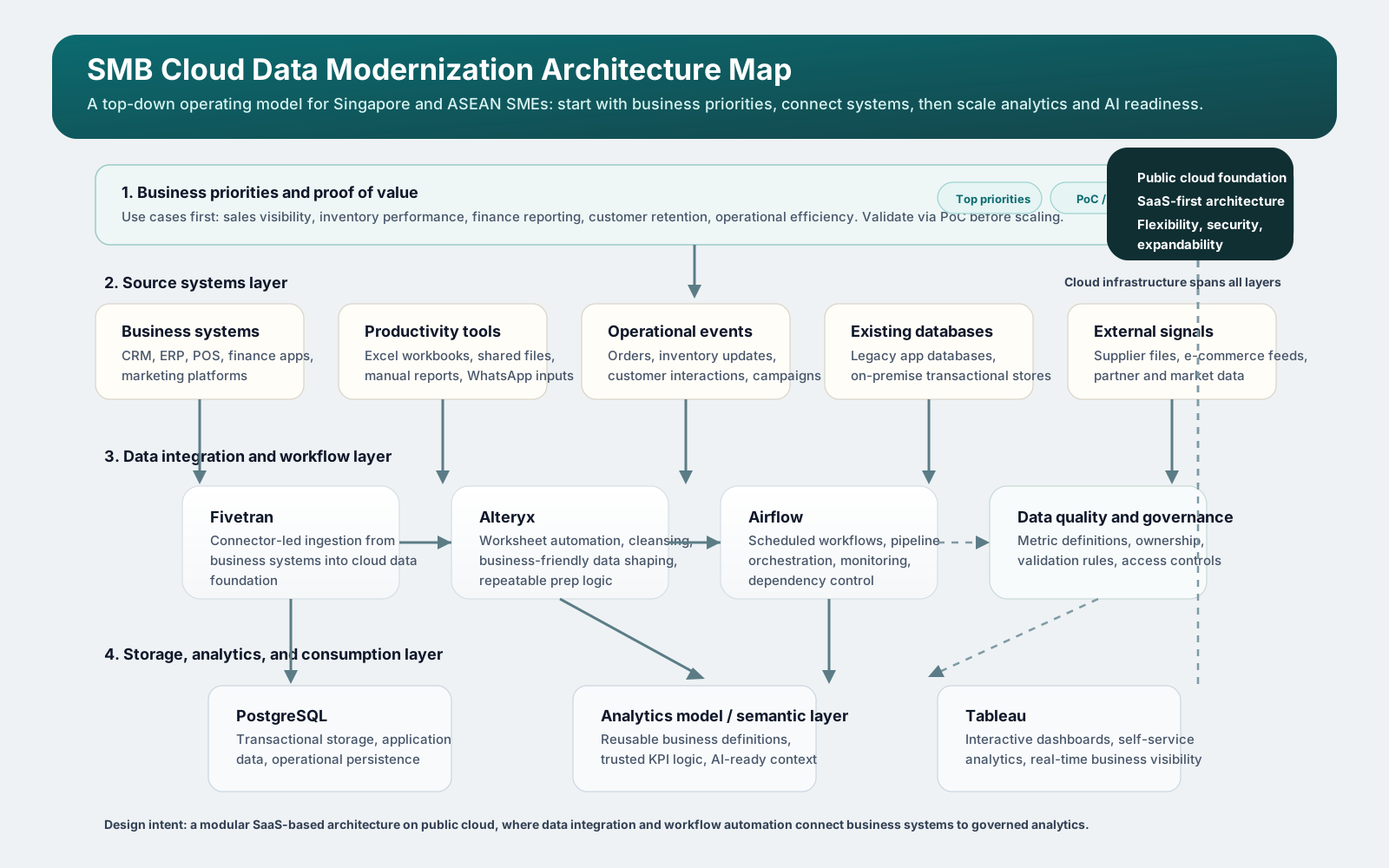
A pragmatic architecture for many growing companies looks like this:
| Component | Tool Example | Primary Role |
|---|---|---|
| Interactive Analytics | Tableau | Self-service dashboards, real-time business visibility, semantic layer |
| Data Ingestion | Fivetran | Connector-led pipeline from business systems into the cloud |
| Data Preparation | Alteryx | Automated cleansing, business-friendly data shaping |
| Workflow Orchestration | Airflow | Scheduled workflows, dependency control, monitoring |
| Storage & Persistence | PostgreSQL | Transactional storage, application back ends |
Core Architecture Diagram
Here is a look at how these pieces fit together into a top-down operating model:
What Executives Should Do Next
Leaders should resist the temptation to pursue enterprise-wide transformation slogans. A better approach is to begin with one or two high-value domains—such as sales performance, inventory, customer retention, or finance close—connect the underlying systems, standardize the critical metrics, and use that domain to create momentum.
For example, an automobile retailer can improve inventory and sales visibility simply by connecting Tableau to their ERP, while a larger retail group might migrate from on-premises systems to the public cloud to prepare for future security and scalability needs. These are not isolated IT wins; they are operating-model shifts.
As enterprise AI adoption becomes mainstream, the organizations that move decisively will be the ones that build trusted context before they scale intelligence.
Looking for help mapping out your data architecture? Drop an email to [email protected]